Self-Portrait
Judith Leyster · c. 1630
Explore the painting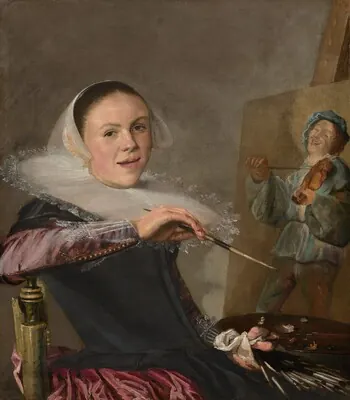
The painting’s story and details
Judith Leyster has turned from her easel and looks directly at us. Around 1630, when she painted this self-portrait, she was about twenty-one. A book about Haarlem had praised her two years earlier. In 1633 she would join the city’s Guild of Saint Luke, later running her own workshop and teaching pupils. This was an unusual professional path for a woman. The self-portrait lets her introduce her skills to prospective patrons.
Parted lips and a slightly turned head suggest a brief pause. Leyster sits sideways, resting her elbow on the chair’s back. Frans Hals developed similar informality in Haarlem portraiture. She adopts a manner of lively engagement familiar to local audiences, combining it with the traditional image of an artist at work.
The brush extends the long line of her hand. It points towards an unfinished violinist whose bow echoes the painter’s instrument. In his catalogue entry, Arthur Wheelock proposes a comparison between two mastered arts. The musician controls sound and the painter colour; both require training and precise movement.
Her other hand gathers a palette, a cloth and a substantial bundle of brushes. Separate portions of paint stand out against the exposed wood. Leyster brings her tools conspicuously into view. A prospective buyer could recognize her profession from them and assess her abilities in the painting itself. A likeness, a translucent cap, folds of fabric and a lively musician offer several demonstrations of skill within one image.
The violinist comes from her Merry Company, dated approximately 1629–1631. Infrared examination found an earlier female face underneath. Wheelock suggests that Leyster may have replaced it to demonstrate her range of subjects or draw on the Merry Company’s success. The reason remains hypothetical; examination confirms the alteration itself.
The broad starched collar would be awkward for painting. Her dress presents Leyster as a person of social standing. Historian Arthur Wheelock connects it to a self-portrait tradition through which painters sought recognition for their profession as a liberal art. Painting involved manual work, but its practitioners also emphasized intellectual achievement. Leyster keeps the fine costume while leaning casually on her chair. She gives her profession dignity without adopting a rigid ceremonial pose.
The self-portrait was later attributed to Frans Hals. It appeared under his name even in exhibitions of the 1930s, when Leyster’s authorship was already being discussed. Her informal manner resembled qualities admired in a famous male painter, making her harder to recognize as an independent artist. We can read the portrait as an effective professional introduction that did not secure a lasting reputation. Recovering her authorship required historical research and the reconsideration of familiar attributions.
Featured in tours
Portraits. How people presented themselves
Rulers, merchants, artists and private patrons before a viewer.
Women painters. Learning and working
Family workshops, academies, private commissions and independent exhibitions.
More paintings to compare



Period, style and subject
- Movement
- Baroque
- Genre
- Portrait
- Medium
- oil on canvas
- Collection
- National Gallery of Art, Washington
- Dimensions
- Overall, 74.6 × 65.1 cm
- Accession number
- 1949.6.1
Sources
Reproduction of a public-domain artwork. Image licence