Las Meninas
Diego Velázquez · 1656
Explore the painting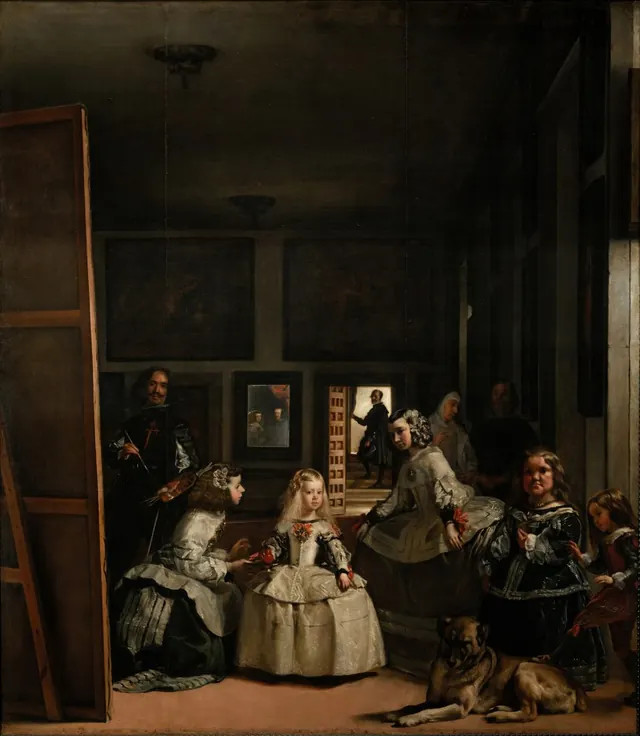
The painting’s story and details
Velázquez painted Las Meninas in 1656 in Madrid’s Alcázar. The Infanta Margarita, her attendants and the artist have gathered in a room within the royal palace that served as his studio. The court consists here of particular people with different responsibilities. Even a brief pause by the princess involves a group of adults whose positions depend on their proximity to the royal family.
Margarita, the daughter of Philip IV and Mariana of Austria, stands in the centre. Light from a window on the right picks out her face and wide silvery dress. Two maids of honour, María Agustina Sarmiento and Isabel de Velasco, attend her. One kneels before the girl; the other inclines towards her. Light and ceremony establish precisely who is being served, despite the figures’ similar scale.
Velázquez stands on the left with palette and brush. He has stepped back from a large canvas and looks ahead. His brush is suspended, showing the decision that precedes a stroke. The Prado relates this self-portrait to the intellectual standing claimed for painting. The court artist fulfilled commissions, but here he occupies a prominent position beside the royal family and determines the arrangement of its image.
Philip IV and Mariana of Austria appear in a mirror on the far wall. Their faces occupy little of the canvas, yet help explain several figures’ forward-facing gazes. The precise origin of the reflection and the subject on the hidden face of the large canvas remain debated. The monarchs themselves remain outside direct view, yet the courtiers are still oriented towards their presence.
At the bottom, Nicolasito Pertusato touches the reclining mastiff with his foot. Mari Bárbola stands nearby. Both were members of the court who had dwarfism; their presence reflects the organisation of that household. The informal gesture beside the dog coexists with the maids’ bows. Everyday movement and ceremony share a room. Velázquez retains distinctions between people to whom court life assigned different roles.
José Nieto, a palace official responsible for the queen’s apartments, stands in the illuminated doorway. His figure is more sharply outlined than the surrounding wall. Steps and the open door extend the room into depth. Whether he is entering or leaving remains uncertain.
The large canvas on the left presents its back. Wooden stretcher bars and a rough surface are visible; its image is concealed. A finished portrait usually removes the studio and the painter’s labour from sight. Here those conditions occupy considerable space. The royal family appears alongside the materials and work through which its image can be preserved.
The upper half contains dim walls and hanging paintings. Illumination is uneven. The bright group beside the window gives way to darkness, followed by renewed light in the doorway. This sequence establishes the depth of the large room. Objects vary in clarity according to their distance and lighting; a face, fold or frame can emerge from a few loosely applied strokes.
The kneeling maid offers Margarita a small red vessel on a tray. Looking after a child takes the form of court service. Rank determines the kneeling posture even when the task is simply to provide a drink. Family intimacy and formal distance meet in this small action. The girl is surrounded by familiar adults, but her birth has already determined how they behave towards her.
The title Las Meninas, meaning the maids of honour, became established in the Prado catalogue only in the nineteenth century. Earlier descriptions identified the picture through the infanta or the royal family. A changed title suggests a different centre for the subject. The canvas includes all these people, together with the painter making their images. Court hierarchy remains intact, while the painter’s authority over its representation becomes visible beside it.
Featured in tours
World classics. Altar, palace, exhibition
Familiar paintings and the people for whom they were made.
Portraits. How people presented themselves
Rulers, merchants, artists and private patrons before a viewer.
More paintings to compare


Period, style and subject
- Movement
- Baroque
- Genre
- Portrait
- Medium
- Oil on canvas
- Collection
- Museo Nacional del Prado, Madrid
Sources
Public Domain. Resized previews and tiles prepared for display; no retouching or upscaling. Image licence