The Lute Player
Orazio Gentileschi · c. 1612/1620
Explore the painting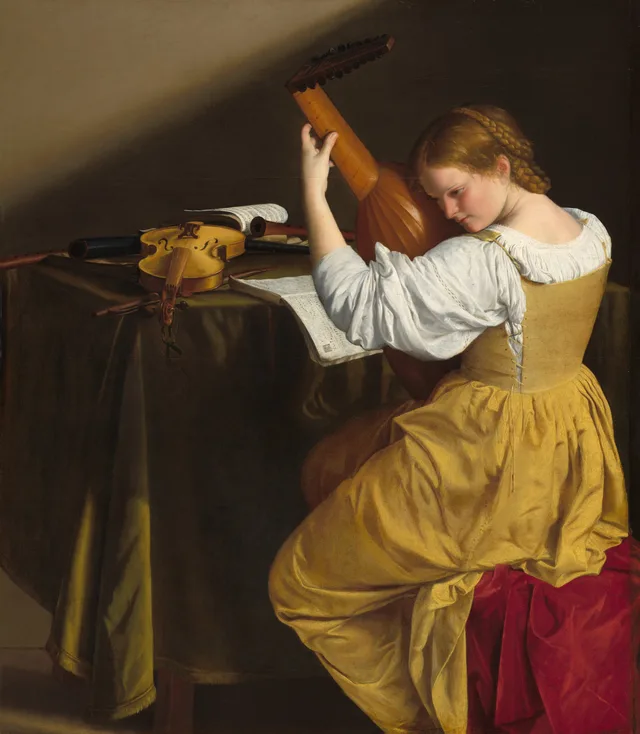
A woman raises her lute and inclines her head toward the strings, tuning before playing. Orazio Gentileschi painted the work around 1612–1620, when musical subjects became important among artists influenced by Caravaggio. He chooses preparation rather than performance. Before music can begin, an individual sound must be heard and carefully checked.
Her head turns toward the instrument and her eyes lower. We see only part of the face because she sits with her back toward us. The activity feels independent of an audience. Her concentration is observed through the inclination of the head and arrangement of the hands.
The raised neck and hand near the tuning pegs distinguish tuning from a standard playing position. The upper arm forms a diagonal continuing through shoulder and torso. Gentileschi joins practical movement with a clear figure design, making the action legible before the objects are examined closely.
Other instruments and open music lie on the table, suggesting an ensemble that may soon gather. The musician is alone, but the prepared setting implies absent participants. Still life points toward a moment beyond the one shown, expanding the action without adding more figures.
The golden dress occupies much of the canvas. Light reveals heavy folds and the cloth’s weight. Signs of mending prevent it from appearing entirely new, grounding the musician in an everyday world. A beautiful image does not require flawless possessions or an ideal mythological being.
The white sleeve emerges sharply from darkness. Light follows shoulder, folds, and arm, emphasizing the working gesture. Caravaggio’s influence is apparent in the lit body within close space, but Gentileschi’s surfaces remain particularly smooth and controlled. Contrast supports a quiet action rather than a sudden dramatic event.
A musical subject allows painting to address a sense it cannot directly convey: hearing. We infer it from the head’s inclination and careful handling of the instrument. The picture influenced later musical scenes and circulated through numerous copies. Its force lies in choosing a moment when sound is still being tested and attention is fully engaged.
- Medium
- oil on canvas
- Collection
- National Gallery of Art, Washington
- Dimensions
- 143.5 × 129 cm
- Accession number
- 1962.8.1
Sources
Museum reproduction. Public domain, NGA Open Access. Image licence