Fatata te Miti (By the Sea)
Paul Gauguin · 1892
Explore the painting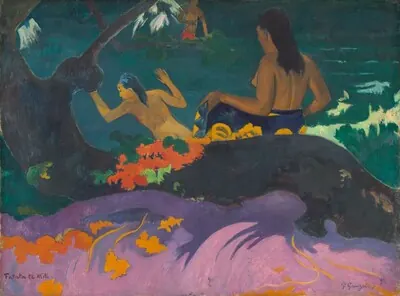
The painting’s story and details
Gauguin painted By the Sea in 1892 during his first stay in Tahiti. He had arrived dreaming of life beyond European conventions. Yet the island was already a French colony, and missionaries and colonial government had transformed local culture. Those circumstances disappear from the canvas. Bathers, a fisherman and a brilliantly coloured shore form the closeness to nature the artist desired.
The nearer woman stands with her back to us, removing a patterned cloth from her hips. Warm ochre sets her back against cool water, while dark hair forms a simple, solid shape. Her face is barely visible. We recognise the movement and preparation for bathing, but her personal history remains outside the painting.
The woman at the left has already leaned towards the water and raised her hands. Her body crosses the calmer vertical of the nearer figure. Their different poses suggest a following moment: one is still undressing, the other ready to plunge in. Dark outlines keep the movement legible among broad areas of colour.
Farther away stands a man with a long spear. The upper edge cuts into his figure, and red clothing appears between the branches. The fisherman introduces an activity that supplies everyday food. Yet his work is shown so briefly that it remains part of the idyll.
A curved trunk crosses the entire foreground. It conceals parts of the figures and separates us from the water. Orange flowers stand out sharply against its dark surface. This barrier brings the shore closer while pushing the bathers away. Its long curve joins the two sides of the picture and finds echoes in the women’s arms and backs.
The sand is pink and violet, the leaves almost pure yellow. Gauguin had already worked with broad flat colours and dark boundaries in Brittany. In Tahiti this established language intensified the impression of an extraordinary place. The shore’s colours serve the composition, so they cannot reconstruct exact lighting or the sand’s actual hue.
Gauguin’s idea of the islands was shaped partly by European travel books and colonial displays at the 1889 Universal Exhibition. Even his route to a “free” life passed through a French artistic mission. The painting carries a significant contradiction. A European sought escape from his society in territory that society had brought under its control, depicting its inhabitants through his own dream.
Featured in tours
After Impressionism. Four different answers
Seurat, Cézanne, Van Gogh and Gauguin changed painting for different reasons.
More paintings to compare
 Paul Gauguin
Merahi metua no Tehamana (Tehamana Has Many Parents or The Ancestors of Tehamana)
1893 Paul Gauguin
Mahana no atua (Day of the God)
1894 Paul Gauguin
Ia Orana Maria (Hail Mary)
1891 Paul Gauguin
Self-Portrait
1889 Paul Gauguin
Where Do We Come From? What Are We? Where Are We Going?
1897–1898 Paul Gauguin
Arlésiennes (Mistral)
1888Period, style and subject
- Movement
- Post-Impressionism
- Genre
- Everyday life
- Medium
- oil on canvas
- Collection
- National Gallery of Art, Washington
- Dimensions
- Overall, 67.9 × 91.5 cm
- Accession number
- 1963.10.149
Sources
Reproduction of a public-domain artwork. Image licence