Ia Orana Maria (Hail Mary)
Paul Gauguin · 1891
Explore the painting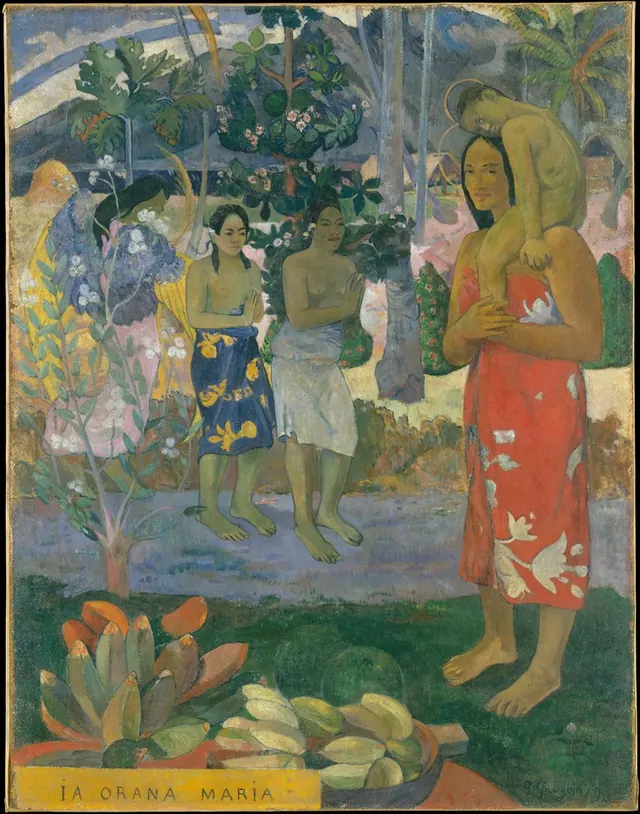
The painting’s story and details
Gauguin arrived in Tahiti in 1891 hoping to find life apart from European industrial civilization. He devoted one of his first large paintings there to Mary and Christ, reimagined as Tahitians. In the new setting, he combines a familiar Christian story with island vegetation and artistic models brought on his journey.
Mary stands on the right, supporting the legs of the child perched on her shoulder. Thin golden halos surround their heads. These small circles identify mother and child as sacred figures. Gauguin retains a familiar sign from European religious painting while changing their appearance, dress, and the way the infant is carried.
An angel with yellow wings appears among the flowers on the left. Vegetation nearly conceals the figure, whose black hair connects it with the other participants. Gauguin explained in a letter that the angel reveals Mary and Jesus to two women. This small presence joins the groups and gives their encounter its religious meaning.
Two women hold their palms together before their chests. Their poses relate to a photograph of a relief at the Buddhist temple of Borobudur in Java that Gauguin used. A model from another religion and another region thus enters this Tahitian Christian scene. Photography enabled forms to travel thousands of miles from their original purpose.
Mary’s red pareo carries large pale flowers. Such cotton textiles also resulted from contact with Europe. Before missionaries introduced them, Tahitian clothing was made from tapa, a material produced from beaten bark. A pattern easily taken as a sign of untouched island life already belongs to a history of trade and religious change.
Fruit, including bananas, lies at the bottom. Its heavy rounded forms occupy the space directly before the viewer. Below it Gauguin wrote the Tahitian title, a greeting to Mary. Inscription and fruit sit at the very edge as an introduction to the scene. A local language carries a Christian salutation.
A pink path recedes behind the figures, and trunks divide the background into narrow sections. Gauguin does not arrange objects in an evenly receding space. Broad color planes bring ground, bodies, and foliage together while outlines keep them distinct. The figures seem to belong to one patterned surface, like a relief or wall painting.
Colonization and Christian missions had already transformed Tahiti. Gauguin sought his own image of paradise and assembled it from disparate sources. His method is unusually clear here. European belief, a Javanese relief, imported cloth, and Tahitian figures form a new composition whose author determines how these cultures will appear together.
Featured in tours
After Impressionism. Four different answers
Seurat, Cézanne, Van Gogh and Gauguin changed painting for different reasons.
More paintings to compare
 Paul Gauguin
Merahi metua no Tehamana (Tehamana Has Many Parents or The Ancestors of Tehamana)
1893 Paul Gauguin
Mahana no atua (Day of the God)
1894 Paul Gauguin
Fatata te Miti (By the Sea)
1892 Paul Gauguin
Self-Portrait
1889 Paul Gauguin
Where Do We Come From? What Are We? Where Are We Going?
1897–1898 Paul Gauguin
Arlésiennes (Mistral)
1888Period, style and subject
- Movement
- Post-Impressionism
- Genre
- Religious art
- Medium
- Oil on canvas
- Collection
- The Metropolitan Museum of Art
- Dimensions
- 113.7 × 87.6 cm
- Accession number
- 51.112.2
Sources
Image provided under CC0. Image licence