Mahana no atua (Day of the God)
Paul Gauguin · 1894
Explore the painting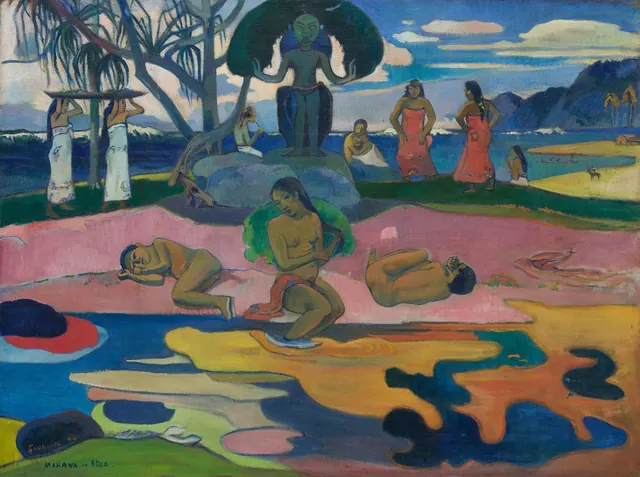
The painting’s story and details
Gauguin painted this Tahitian scene in Paris in 1894, after returning from his first visit. Women rest beside water while others carry offerings or stand before a deity. Gauguin invented this sacred place from memories and artistic models. Travel experience becomes a promise of another life for a European audience.
The deity raises both hands at the centre. A dark tree repeats its silhouette. The figure makes the gathering resemble a ceremony, although Gauguin creates his own combination of people and actions. Under colonial rule, Christian missions had already substantially altered local religious life.
Women on the left carry long dishes on their heads. Similar white clothes and repeated arms connect them into a procession. Repetition makes the action legible. Individuals give way to participants in the painter’s constructed ritual.
Two women in red stand to the deity’s right. Their nearly identical dresses form a conspicuous pair. Red recurs at the other end of the bank, connecting distant groups. Gauguin distributes participants in his invented ceremony through colour and position, giving the gathering a deliberate order.
At the foreground centre a nude woman lowers her feet towards the water. Her head bends and her arms draw close to her body. Her gesture differs from the deity’s raised hands, giving the foreground another pace. Behind the still figure on the bank, a procession carries offerings.
The figure on the right lies facing away from us with bent legs. The body’s contour closes in on itself and the face almost disappears. Its position echoes the figure at the opposite end of the bank. This connection makes the number of distinct people in the foreground an important question.
Another reclining figure faces us on the left. The museum allows that the pair may show one person from different viewpoints. That interpretation changes the event. A painting can combine views of a body without representing one instant in one place.
Yellow, red, blue and greenish areas divide the water. They suggest reflections without consistently repeating objects above them. Colour acquires independent shape. Shore and pool become among Gauguin’s most adventurous passages, bringing a recognisable world close to abstraction.
Back in France, Gauguin showed island subjects to people who had mostly never visited Tahiti. His inventions could be received as evidence of another culture. This gave the painter considerable power over the island’s image for European audiences. The invented ceremony reveals his own artistic pursuits and a European desire to discover a lost paradise far from home.
Featured in tours
After Impressionism. Four different answers
Seurat, Cézanne, Van Gogh and Gauguin changed painting for different reasons.
More paintings to compare
 Paul Gauguin
Merahi metua no Tehamana (Tehamana Has Many Parents or The Ancestors of Tehamana)
1893 Paul Gauguin
Ia Orana Maria (Hail Mary)
1891 Paul Gauguin
Fatata te Miti (By the Sea)
1892 Paul Gauguin
Self-Portrait
1889 Paul Gauguin
Where Do We Come From? What Are We? Where Are We Going?
1897–1898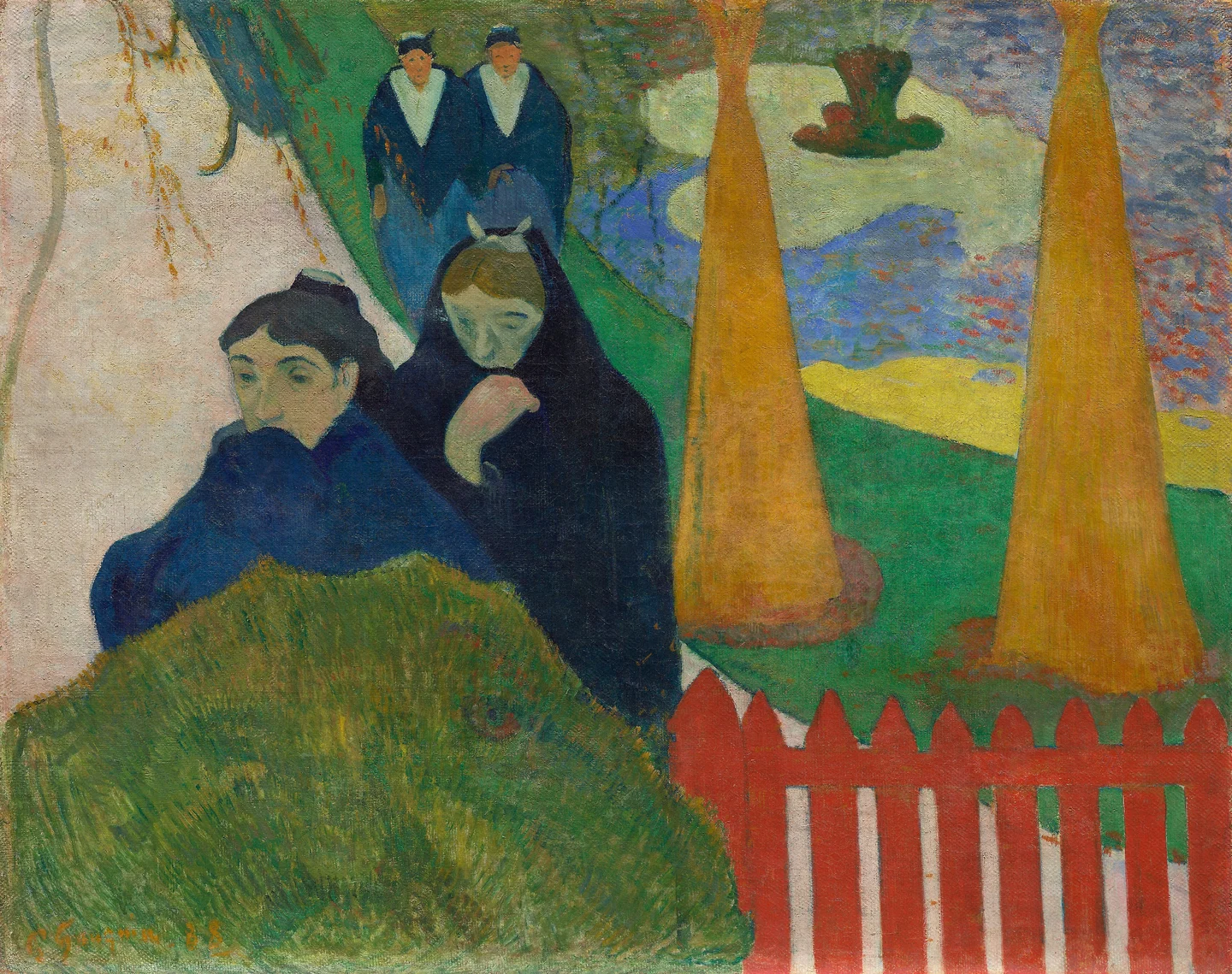 Paul Gauguin
Arlésiennes (Mistral)
1888Period, style and subject
- Movement
- Post-Impressionism
- Genre
- Imagined worlds
- Medium
- Oil on linen canvas
- Collection
- Art Institute of Chicago
- Dimensions
- 68 × 91 cm
- Accession number
- 1926.198
Sources
Image provided under CC0. Image licence
Adapted and translated from Art Institute of Chicago materials. · Text licence