Rouen Cathedral, West Façade, Sunlight
Claude Monet · 1894
Explore the painting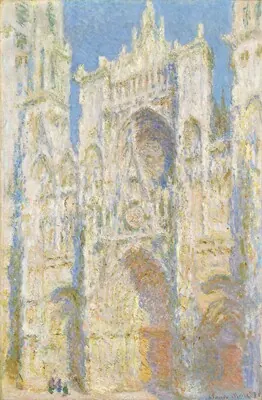
The painting’s story and details
In 1892 and 1893 Monet worked opposite Rouen Cathedral, switching canvases as the light changed. He later reworked the series in his studio; this painting bears the date 1894. The medieval monument proved an especially demanding subject. The building stayed put, but shadows in its carving and the colour of its stone changed faster than the painter could record them.
Nested pointed arches rise above the central entrance. Blue and violet shadows mark their depth; yellow and pink light catches the projecting parts. Warm and cool patches do the work of architectural drawing. From a distance the portal looks massive; close up the individual strokes separate, and its stone surface ceases to look smooth or continuous.
A tall triangular gable partly overlaps the circular rose window. Monet preserves enough of the façade’s structure for the building to remain recognisable. Yet the window’s fine tracery merges with neighbouring touches of colour. Here it conveys sunlit carving in which the eye catches both detail and dazzling light.
At the left, the tower extends beyond the upper boundary. Irregular pale strips run along its verticals, with blue showing between them. The cathedral fills the canvas so tightly that almost no room remains for the square. This viewpoint intensifies the great wall’s proximity. Only part of the monument is visible, as though we had come too close to take in the whole.
The sky remains a clear blue gap between the pinnacles. The same blue appears in the stone, especially in its recesses, linking architecture with the surrounding air. Yet the paint is thick, forming its own relief in places. The work conveys rapidly changing light through a material layer Monet built up and reworked over time.
At the lower left, a few blue and green touches indicate people. Almost lost beside the entrance, they restore a human scale to the building. The cathedral still belongs to the city and its daily life. Monet gives the passers-by only a few strokes, reserving almost all the space for stone meeting sunlight.
In 1895 twenty paintings from the series were exhibited together. The politician and critic Georges Clemenceau devoted an article, “The Revolution of the Cathedrals,” to them, connecting the many views with the continuous passage of time. A Gothic monument bound closely to French history had preserved its form over centuries. Monet made changes appearing on its surface within a day the subject of a major exhibition.
More paintings to compare


Period, style and subject
- Movement
- Impressionism
- Genre
- Landscape
- Medium
- oil on canvas
- Collection
- National Gallery of Art, Washington
- Dimensions
- Overall, 100.1 × 65.8 cm
- Accession number
- 1963.10.179
Sources
Reproduction of a public-domain artwork. Image licence