The Suitor's Visit
Gerard ter Borch the Younger · c. 1658
Explore the painting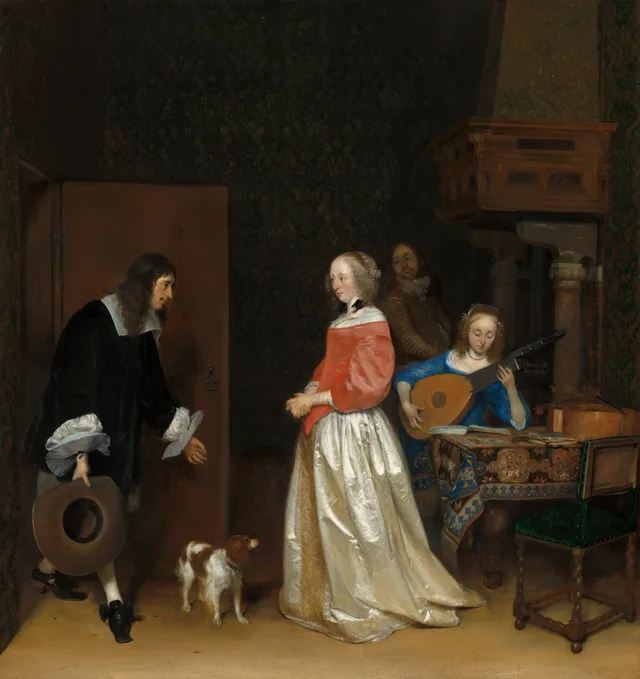
A man removes his hat and bows to a young woman. Music continues behind them while another guest stands by the fireplace. Ter Borch painted The Suitor’s Visit around 1658, when small scenes of prosperous domestic life found buyers in Dutch towns. Viewers could admire the execution and interpret the relationships, which the scene leaves intriguingly unsettled.
The visitor leans forward, holds his hat low, and extends his free hand. His gestures await the woman’s response. Black clothing almost merges with the room, making the white cuffs prominent. Ter Borch focuses attention on courteous behavior. Social distinction can be conveyed through manners as clearly as through expensive dress.
The light satin skirt occupies the center. Sharp highlights meet soft gray shadows in its folds. Ter Borch was especially admired for painting this material. The fabric displays the household’s prosperity while also demonstrating the artist’s skill. A buyer acquired the continuing pleasure of studying an object that seems almost palpable.
The woman holds her hands before her and looks at the visitor, answering his bow with greater restraint. Small differences in gesture generate possible readings. Museum scholars discuss both a conventional social call and a more intimate invitation. This uncertainty belongs to the scene’s construction, with its decisive conversation left unheard.
The seated woman plays a theorbo, a long-necked member of the lute family. Music gives the company a shared activity and suits the subject of courtship. Yet the musician attends to her instrument while the first pair attend to each other. The distribution of attention makes the scene a set of related actions rather than a posed group.
The man behind warms his hands at the fireplace. Upholstery, carved wood, and a table carpet fill the room with crafted comforts. Painting incorporates them into an image of agreeable private life. In the foreground, a small dog enlivens the encounter and helps connect the figures across the lower composition.
Ter Borch turns viewers into observers of other people’s manners. We assess a bow, an answer, clothing, and the distance between figures almost like guests in the room. His scenes influenced Dutch painters including Vermeer and Metsu. Quiet action combined with close attention to surfaces could sustain looking far longer than the apparent simplicity of an encounter suggested.
Featured in tours
Domestic life. Leisure and care
Sixteen paintings about reading, music, children and the work that makes domestic comfort possible.
- Medium
- oil on canvas
- Collection
- National Gallery of Art, Washington
- Dimensions
- 80 × 75 cm
- Accession number
- 1937.1.58
Sources
Museum reproduction. Public domain, NGA Open Access. Image licence