Yellow Dancers (In the Wings)
Hilaire Germain Edgar Degas · 1874–76
Explore the painting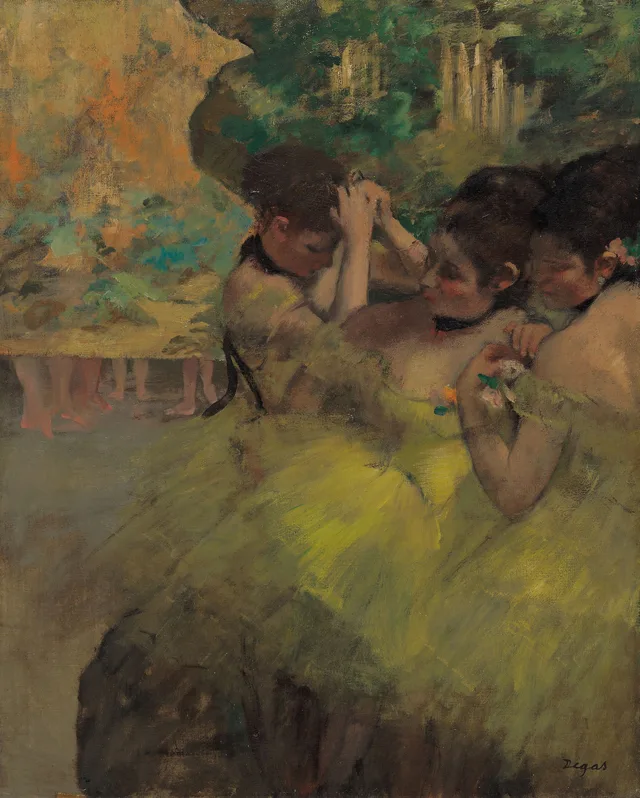
Degas places us in the wings of the Paris Opéra. Dancers gather closely before going on, adjusting hair and costumes. He began treating ballet as an independent subject in 1871 and returned to it over decades. Yellow Dancers was completed for the second Impressionist exhibition in April 1876. Displaying the painting made a part of theatrical life accessible to a wider audience than the ordinary spectator could observe from a seat in the auditorium.
The dancer on the left raises both hands to her head. Her elbows form sharp angles, her neck bends and her face is partly hidden. The movement is not intended for an audience, yet demands as attentive a drawing as a stage pose. Degas had long been interested in complex bodily positions. Ballet allowed him to pursue that investigation among his contemporaries. An academic study of the figure moved from historical narrative into the everyday work of professional performers.
Near the centre, one head almost touches another. Faces turn downwards and sideways, preventing the formation of a conventional formal portrait. We distinguish separate activities without receiving complete stories about each girl. Their closeness suggests how the wings function. A large spectacle has a narrow working edge where performers wait, prepare and make room for one another. Overlapping heads and shoulders make that organisation visible.
On the right, hands attend to the bodice and shoulder. A green accent stands out against yellow fabric and warm skin. Preparing a costume receives as much attention as a face. Today this can seem an intimate view of creative labour. The observer’s position also matters, however. Influential Opéra subscribers enjoyed backstage access, and proximity to performers was part of their privilege. The painting reveals work while also reproducing an inequality in who was allowed to witness it.
Yellow skirts spread across much of the lower canvas. Broadly applied paint leaves darker underlayers visible in places. The costumes acquire airiness without every layer of fabric being described. Above, the figures are tightly interwoven; below, a large field of colour unites them. Degas balances the impression of a chance sight with a clear pictorial structure. Informality is the result of selection, rather than an absence of composition.
Farther back on the left, a row of other dancers’ legs remains visible while their upper bodies disappear among the scenery. This cropped fragment implies activity beyond the main group. Yellow-green stage scenery connects with the costumes without erasing the difference between a painted forest and performers’ bodies. The spectacle consists of conventions and physical people. In the wings those layers sit beside one another, not yet combined into the unified image presented to an audience.
A theatre audience pays to watch movement made to look effortless. Degas restores preparation, waiting and restricted space to that effect of ease. Yet he also turns someone else’s work into an artistic spectacle. This ambiguity makes the painting more interesting than a straightforward exposure of theatrical beauty. We can admire its colour, follow the skill of the drawing and notice the position from which we are permitted to look. None of these responses cancels the others.
More works by Hilaire Germain Edgar Degas
 Edgar Degas
The Dancing Class
 Hilaire Germain Edgar Degas
The Millinery Shop
 Hilaire Germain Edgar Degas
A Woman Seated beside a Vase of Flowers (Madame Paul Valpinçon?)
 Hilaire Germain Edgar Degas
The Dance Class
 Hilaire Germain Edgar Degas
Young Spartan Girls Challenging Boys
 Hilaire Germain Edgar Degas
Portrait after a Costume Ball (Portrait of Madame Dietz-Monnin)
- Medium
- Oil on canvas
- Collection
- Art Institute of Chicago
- Accession number
- 1963.923
Sources
Wikimedia Commons reproduction. Public domain. Image licence