Paris Street; Rainy Day
Gustave Caillebotte · 1877
Explore the painting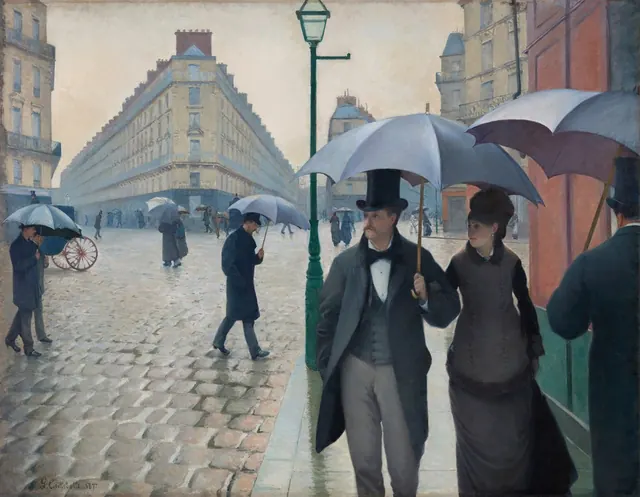
The painting’s story and details
The pedestrians at this junction are finding their way through a recently rebuilt Paris. Broad avenues and stone apartment buildings with regular rows of windows have replaced cramped medieval streets. In 1877 Caillebotte chose a familiar spot near his home and gave an ordinary walk a canvas almost three metres wide. Everyday life acquired the scale of a major history painting.
The man in the top hat comes almost within touching distance. His size, compared with the other pedestrians, makes our proximity to the couple unusually tangible. People diminish in stages towards the distance. Caillebotte calculated their positions so that movement through the street would feel convincing and each figure would occupy a precise place in perspective.
The woman stays close to her companion. Both look to our left, beyond the picture, while another pedestrian approaches from the right, reduced to a cropped back and umbrella. We see only part of a larger event. The museum relates this cropping to the possible influence of photography.
The grey umbrella shelters the couple and conceals a substantial part of the building. Similar canopies recur in the distance. Newly available retractable umbrellas, fashionable clothes and rebuilt streets belong to the same modern world. These objects and the wet pavement convey the weather without individually painted raindrops.
The green lamp almost divides the canvas in half. Its firm vertical helps us compare two very different spaces. On the left the street opens broadly into the distance; on the right large figures crowd the edge. The immense junction can therefore contain the feeling of a sudden encounter with people about to pass very close by.
The wedge-shaped building reveals the sharp angle between the avenues. Windows and cornices converge in the distance. The rebuilding of Paris changed residents' routes as well as their surroundings. Architecture determines how we explore this scene, following straight streets across an open junction and between widely separated groups.
A cartwheel appears behind the pedestrian on the left, introducing everyday work beside the fashionable stroll. Traffic at the junction consists of separate activities whose participants hardly acknowledge one another. It is difficult to take everything in at once, much as it is difficult to follow every pedestrian on a real street. The central couple receives far more space than this small episode. That distribution encourages us to associate modern Paris above all with fashionable pedestrians. Following the small details of labour instead may change our impression of the same street.
Light and dark patches describe the wet cobbles. Large stones near us merge into a shimmering surface farther away. Caillebotte gives the visual experience of rain as much attention as the clarity of his drawing. He exhibited with the Impressionists while retaining a more restrained painting technique.
The apparently accidental encounter results from carefully calculated scale, perspective and intervals between figures. Caillebotte presents modern Paris through a pedestrian's experience. The Art Institute acquired the canvas in 1964, before his contribution to Impressionism was widely acknowledged. This everyday intersection remains one of his most recognisable images.
Featured in tours
For children. Everyday life before us
Homes, school, trains and games in twelve paintings. For ages 8–12 and adults.
Early Impressionism. Paris 1860–1879
The Salon, the first independent exhibition, railway stations, studios and leisure on the Seine.
World classics. Altar, palace, exhibition
Familiar paintings and the people for whom they were made.
More paintings to compare




Period, style and subject
- Movement
- Impressionism
- Genre
- Landscape
- Medium
- Oil on canvas
- Collection
- Art Institute of Chicago
- Dimensions
- 212.2 × 276.2 cm
- Accession number
- 1964.336
Sources
Image provided under CC0. Image licence
Adapted and translated from Art Institute of Chicago materials. · Text licence