The Gulf Stream
Winslow Homer · 1899; reworked by 1906
Explore the painting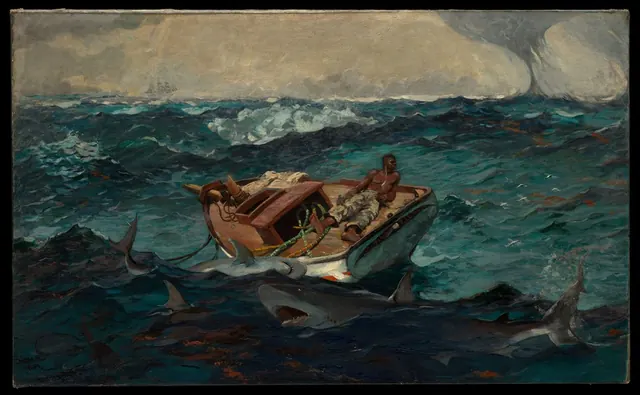
The painting’s story and details
A Black man is alone on a damaged boat. Sharks surround him; a waterspout appears on the right horizon, and a ship is barely visible on the left. Homer painted The Gulf Stream in 1899 and continued revising it through 1906. The idea developed from visits to the Bahamas and Cuba. The tropical sea becomes a place where an ordinary voyage can turn into a struggle for survival.
The man reclines on the deck, raising his head and turning to the right. His body catches the light, and his muscles and extended neck are clearer than his expression. He looks away from the distant ship. The clearly modelled figure remains a principal light area among dark waves and wreckage.
The mast is broken, the sail lies bundled on deck, and rigging hangs over the side. The boat is still afloat but has limited means of manoeuvring. A wave lifts its bow, bringing the rail close to the foam. Sugarcane lies between the man’s legs and the cabin entrance. This cargo introduces Caribbean trade into the marine subject: the vessel belongs to a world of work and transported goods.
A large shark opens its mouth near the painting’s front edge. Its grey body crosses the dark water alongside other fins and tails. Homer brings this danger close to the viewer; sea fills the space between us and the boat.
On the right, a waterspout joins a cloud to the sea. Its narrow column stands far beyond the boat, but its scale against the horizon makes it conspicuous. Nearby waves consist of thick blue and green bands beneath a much paler sky. Danger surrounds the man at several distances.
A large sailing ship appears on the left horizon. Its pale sails almost dissolve into the sky, making it easy to notice only the boat and sharks at first. The ship introduces the possibility of help, but the painting does not show whether anyone aboard has noticed the castaway. Homer preserves a wide interval between the two vessels.
The title names a current connecting the Caribbean, the eastern coast of North America and the Atlantic. The museum interprets the sugarcane and the Black seaman in relation to plantation economies and slavery’s legacy. The painting followed the Spanish-American War of 1898, which expanded United States influence in the Caribbean. It adds another question to the natural danger: what position did this person occupy within the world of trade and empire along whose routes his boat is moving?
Featured in tours
American landscape. Land and its inhabitants
Nature, territorial expansion, the Civil War and urban life in American painting.
More paintings to compare
Period, style and subject
- Movement
- Realism
- Genre
- Marine painting
- Medium
- Oil on canvas
- Collection
- The Metropolitan Museum of Art
- Dimensions
- 71.4 × 124.8 cm
- Accession number
- 06.1234
Sources
Image provided under CC0. Image licence