Dressing for the Carnival
Winslow Homer · 1877
Explore the painting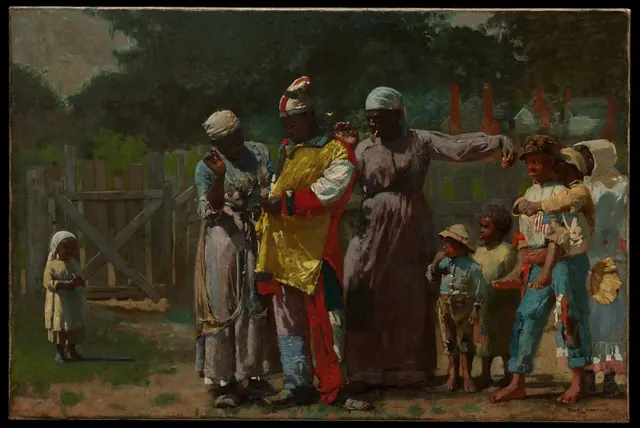
The painting’s story and details
Two women finish a performer’s costume while children wait nearby. Homer originally titled the painting Sketch—4th of July in Virginia. It brings together American Independence Day and Jonkonnu, a tradition preserved by enslaved people of African descent. After the Civil War, the older custom found a new place in public life. Preparing an outfit becomes part of celebrating freedom that this community had only recently gained.
The man wears a bright outfit assembled from yellow, red and white fabric. Mismatched trouser legs, a tall cap and long strips distinguish him from everyone else. He remains almost still while the women finish their work. Yellow fabric across the chest and red sleeves occupy the illuminated centre. Surrounding greys, greens and browns make the costume immediately conspicuous.
The woman on the left sews at his waist. One hand is raised with a needle, while the other stays beside the fabric. This is a precise practical detail: the outfit is being fitted directly on its wearer. Her own dress is visibly worn and divided into differently lit passages. Festive clothing takes shape under the same conditions in which people repair and maintain ordinary belongings.
The older woman on the right holds a pipe in her mouth and extends an arm as she draws out the thread. Her gesture makes a long horizontal above the children. The two women organise the group’s activity through their sewing. They determine how the performer will appear. Sewing, usually kept outside the public performance, occupies a central place here.
Two younger children stand beside her skirt. One holds a finger to his mouth and lowers a hand carrying a small American flag; the other watches the sewing. The flag connects the yard to a national holiday. The children remain absorbed in nearby activity. The date’s political significance enters through an object small enough to hold and a shared custom.
An older child in blue trousers carries a baby. Ragged clothing and bare feet remain clear beside the outfit’s red strips. Holiday preparations do not conceal material circumstances. Caring for a younger child coexists with waiting for a performance. Homer distributes these activities among different figures, preserving varied poses within a closely packed row.
A little girl stands apart on the left, beside the gate. A strip of sunlit ground separates her from the others. She faces the group, but her figure remains distinct. This interval changes the rhythm of the scene. The preparations appear as a neighbourhood event that someone might join or watch from a short distance.
Pale houses and red chimneys rise beyond the wooden fence. This is a residential setting without a special ceremonial space. In 1877, the year of the painting, Reconstruction—the postwar reorganisation of the South—was ending. Federal troop withdrawal weakened protection for Black Americans’ rights. Celebrating independence took on particular urgency in a society where its participants’ rights were becoming vulnerable again.
Homer already knew Virginia through his work as an artist-correspondent during the Civil War. He later returned to life after emancipation. Here, history appears through preparations for a shared celebration: sewing, waiting and looking after children.
Featured in tours
American landscape. Land and its inhabitants
Nature, territorial expansion, the Civil War and urban life in American painting.
History in painting. Events and memory
Who painted war, revolution and state power, and how long after the event.
More paintings to compare
Period, style and subject
- Movement
- Realism
- Genre
- Everyday life
- Medium
- Oil on canvas
- Collection
- The Metropolitan Museum of Art
- Dimensions
- 50.8 × 76.2 cm
- Accession number
- 22.220
Sources
Image provided under CC0. Image licence