Édouard Manet
Henri Fantin-Latour · 1867
Explore the painting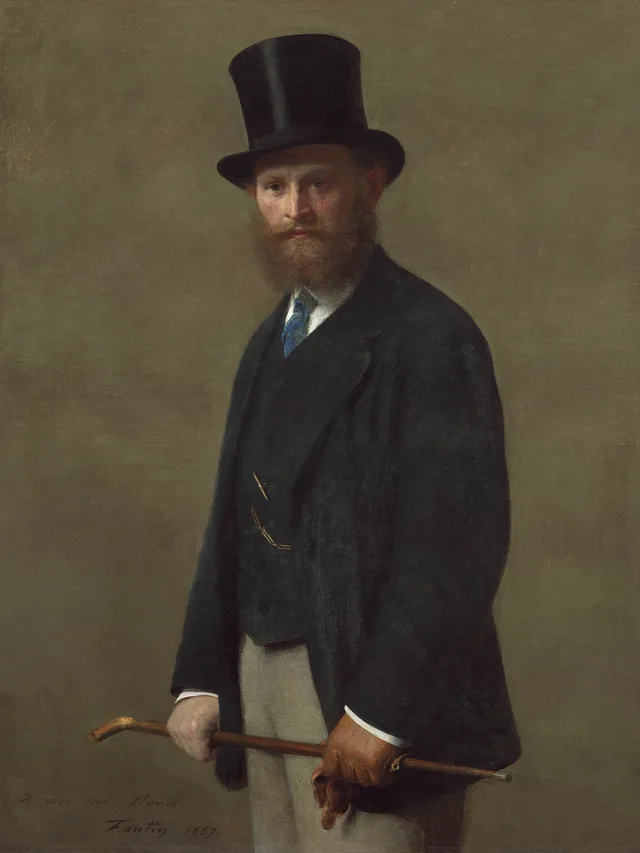
In 1867 Fantin-Latour portrayed his friend Édouard Manet as an elegantly dressed Parisian. The public already knew Manet through controversial paintings. This portrait shows the person behind that reputation. A top hat, gloves, and cane place him within respectable urban society, where artistic boldness could coexist with careful dress and social convention.
The tall hat occupies a substantial part of the upper composition. A narrow highlight conveys its sheen, while the brim shades the forehead. For contemporary viewers, this accessory immediately established a familiar urban appearance before they began examining the sitter’s individual features.
Manet faces forward. His reddish beard and mustache are softly painted, with deeper shadows around the eyes. There is no theatrical turn or gesture. The face remains available for sustained observation, intensified by a neutral background without studio objects or a competing narrative.
The dark jacket, waistcoat, and pale trousers differ in tone and texture. A blue tie provides a small accent, while a gold chain marks the waistcoat. Manet holds neither palette nor brush. Recognizing the artist depends on knowing his identity rather than reading a professional attribute.
The cane runs across almost the full width of the figure. One hand is bare; the other wears a brown glove and holds its companion. This asymmetry keeps the pose from becoming rigidly balanced. The cane connects the hands and anchors the lower composition, giving a walking accessory a structural role.
At lower left, the inscription dedicates the painting to the artist’s friend Manet and records the date. It establishes the relationship behind the image: one painter’s view of a colleague he knew personally. The friendly dedication also accompanies a public presentation shaped through dress, posture, and restrained handling.
The empty background recalls both contemporary portrait photography and Manet’s own isolated figures. Fantin-Latour uses a familiar visual language to shape his friend’s image. An artist’s reputation emerges here as something formed through several channels, including portraits made and circulated by the people around him.
- Medium
- Oil on canvas
- Collection
- Art Institute of Chicago
- Accession number
- 1905.207
Sources
Wikimedia Commons reproduction. Public domain. Image licence