In the Evening
Abram Arkhipov · c. 1910
Explore the painting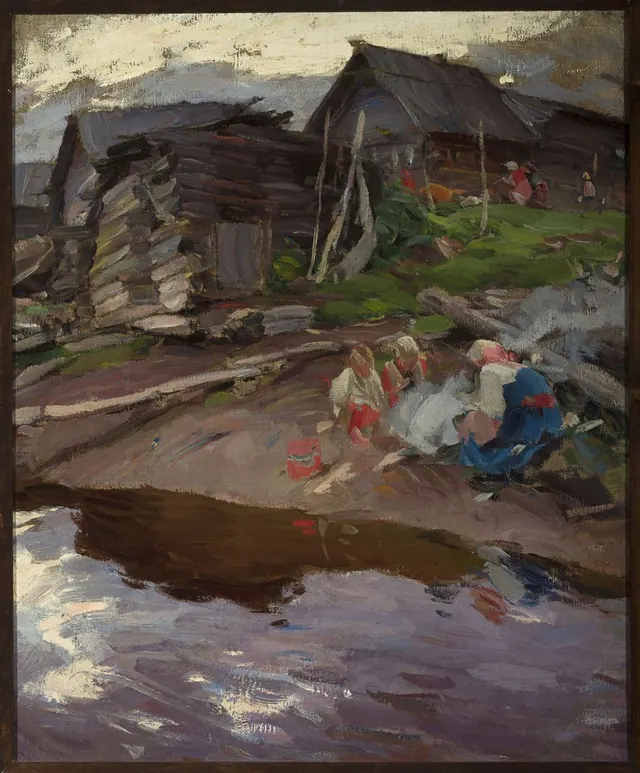
The painting’s story and details
Peasant women have gathered beside the water, with log buildings on the bank above. Arkhipov painted this village evening around 1910, when he was already known for scenes of peasant life. His teachers included Perov, Savrasov and Polenov. This Moscow training encouraged close attention to everyday surroundings and to the way natural light changes colour. Both concerns come together in this small stretch of riverbank.
Women in headscarves sit close together in the foreground. White sleeves and blue and red fabrics stand out against the dark ground; a red bucket sits nearby. Their faces are suggested with a few strokes. Turned towards one another, they form a close group at the water’s edge.
A boat crosses the foreground as a long dark shape. The high bank and close viewpoint make its hull partly merge with the ground. Water reaches almost to the buildings, approached by worn slopes and laid boards. The landscape includes the village’s working surroundings.
On the log building at the left, the ends of the timbers, a low door and a sloping roof remain distinct. Arkhipov follows the grain with strokes of grey, brown, mauve and ochre. The wall appears assembled from separate, heavy pieces. Outlines break off in places, and the support shows through thin paint. This loose brushwork conveys aged timber and evening light without describing every log in detail.
Another group stands higher up, beside the house. Their figures are much smaller, but red and pale patches of clothing remain visible. A green slope separates the two groups. The village unfolds vertically, from the water to the houses. Arkhipov gives distant faces and objects few details, retaining the silhouette, position and colour that make them recognisable.
At the bottom, reflections spread into broad pale bands. Whitish sky, mauve shadows and the dark bank break up in the water; a tiny red mark repeats the bucket’s colour. Colour connects a person, an object and a reflection across the surface. The paint remains conspicuous even where it depicts something readily recognisable. Traces of the moving brush are especially clear beside smoother, dark passages.
Around 1903–1904, Arkhipov helped establish the Union of Russian Artists. Village subjects and local architecture became important to its members’ understanding of Russian culture. Bright fabrics and lively handling make village surroundings appealing to an urban audience. Material conditions remain visible here, in rough buildings, an unpaved descent and the proximity of domestic activity to the water.
Featured in tours
Russian life. Estate, city and village
How nineteenth-century painters depicted work, wealth, education and changes in everyday life.
More paintings to compare


Period, style and subject
- Movement
- Impressionism
- Genre
- Everyday life
- Medium
- Oil on canvas
- Collection
- National Museum in Warsaw
- Dimensions
- 88 × 72.5 cm
- Accession number
- M.Ob.1525
Sources
Public domain. Reproduction from Wikimedia Commons. Image licence