The Child's Bath
Mary Cassatt · 1893
Explore the painting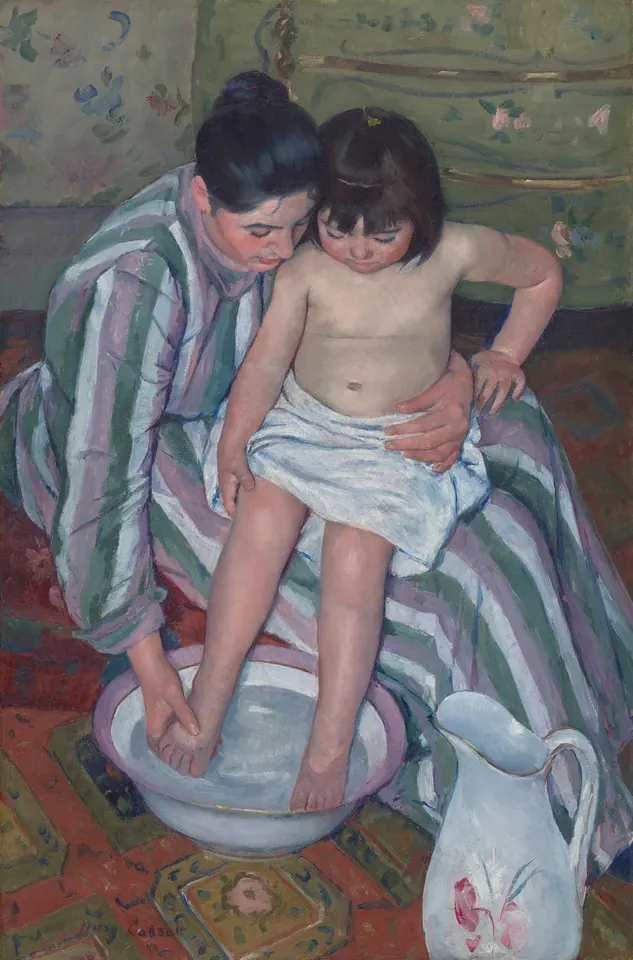
The painting’s story and details
Bathing a child involves practical actions. The woman holds the child on her lap, supports the waist and washes a foot in a basin. Cassatt makes this domestic work the central event. Closeness emerges through touch and a shared activity. The museum calls the adult a caregiver; the image alone does not establish the pair's precise relationship.
The woman bends until her cheek almost touches the child's shoulder. Their heads come together and their eyes turn downwards. Cassatt repeatedly explored relations between women and children, attending to the bodily actions of care. Here she has no need for smiles directed towards the viewer or a formal portrait pose.
We look down on the child's face, shoulders, knees and the water. This steep viewpoint relates to Cassatt's interest in Japanese prints. Following a major Paris exhibition in 1890, she made a series of colour prints, then continued exploring unusual viewpoints in painting. The Child's Bath dates from 1893.
The child's hand rests on the woman's knee while the adult's other arm circles the waist. These reciprocal gestures provide support while the woman washes a foot. The visible relation between hands and bodies gives the account of care its precision.
White fabric around the hips separates bare skin from the striped dress. Folds carry cool shadows, while the adjacent skin is painted more evenly. Cassatt varies her handling with each surface but retains clear boundaries, allowing the figures to remain legible among the many patterns.
The round basin sits close to the lower edge. We can see its outer wall, the water and the hand supporting a foot at once. Seen from above, the room seems shallower. Objects rise across the canvas while the whole scene remains close to us. This is one of the devices Cassatt developed through studying Japanese prints.
Flowers on the pitcher sit beside the carpet's ornament and the patterned wall. Each object has its own texture, but the viewpoint brings their designs together. There is almost no neutral background. Household objects actively shape the composition and establish a rhythm around the two large figures.
The dress stripes curve around the woman's knees and elbow. Their turns help us reconstruct her posture even without looking at the faces. Firm outlines, large patterns and compressed depth explain the Japanese influence more precisely than a general label such as decorative. Cassatt selected methods from another artistic tradition to develop her own subject.
Cassatt was the only American invited to exhibit with the original French Impressionist group. Her engagement with contemporary life encompassed domestic labour and relations between adults and children. Here the experiment with perspective is closely connected to the mechanics of bathing. The painting brings us near enough to recognise care through its movements. A different emphasis is also possible. Following bodily support and the sequence of movements reveals work requiring attention and skill. The tenderness of the scene does not remove that labour. It invites discussion of the actions that an apparently simple word such as care can leave unnoticed.
Featured in tours
For children. Everyday life before us
Homes, school, trains and games in twelve paintings. For ages 8–12 and adults.
Women painters. Learning and working
Family workshops, academies, private commissions and independent exhibitions.
More paintings to compare

Period, style and subject
- Movement
- Impressionism
- Genre
- Everyday life
- Medium
- Oil on canvas
- Collection
- Art Institute of Chicago
- Dimensions
- 101.3 × 67.3 cm
- Accession number
- 1910.2
Sources
Image provided under CC0. Image licence
Adapted and translated from Art Institute of Chicago materials. · Text licence