At the School Door
Nikolai Bogdanov-Belsky · 1897
Explore the painting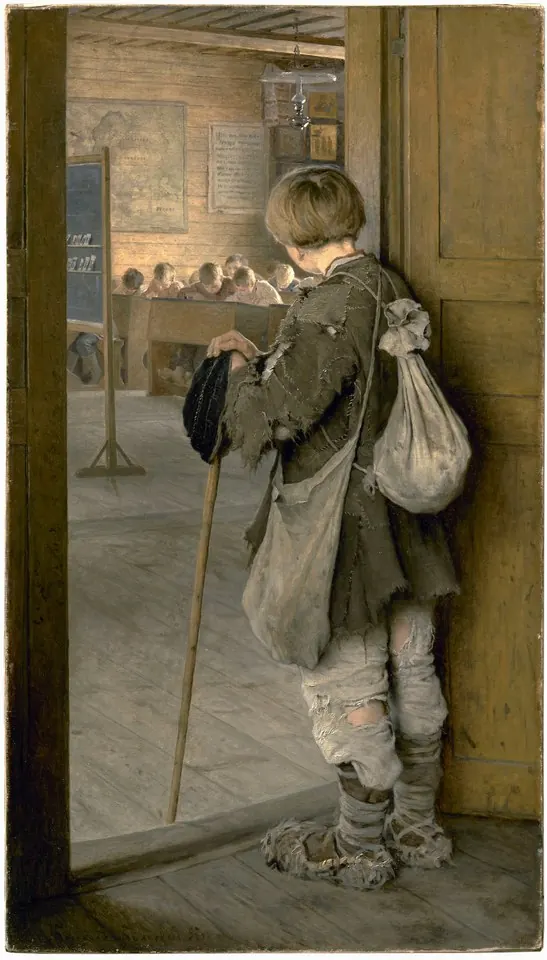
The painting’s story and details
A boy pauses at an open doorway while other children study inside. Nikolai Bogdanov-Belsky painted him in 1897. Born into a peasant family, the artist attended Sergei Rachinsky’s school in Tatevo before receiving artistic training in Moscow and St Petersburg. A village school therefore had a personal significance for him. The Russian Museum suggests that memories may have informed the subject. A path towards education familiar to the artist begins here with a pause outside a classroom.
The boy faces the classroom with his back towards us. He holds his removed cap, with a long stick in front of his body. His face is mostly hidden, making the turned head and still feet more noticeable. The doorway is wide enough to enter. The painter suspends the action at its threshold, turning the distance to the pupils into the scene’s central concern. No meeting with a teacher has yet taken place.
A tied bundle hangs behind his shoulder and a large canvas bag at his side. Pale cloth stands out against dark clothes and the wooden door. The child carries his possessions himself, with no accompanying adult in view. He looks independent and vulnerable at once. The bulky bags distinguish him from the children already settled at the table.
The bast shoes fray at their edges, leg wrappings have slipped, and skin shows through tears in his clothes. These details receive much closer treatment than the pupils inside. Their scale makes us notice the child’s material circumstances before his abilities. Yet the direction of his head takes us from worn possessions towards schoolwork. Need and the possibility of learning are separated by one step not yet taken.
Children bend over their work at a long table. Their heads recur across a strip of light, none shown as prominently as the boy at the door. An empty floor lies between table and threshold, marking the distance he has yet to cross. The activity is available to his eyes before he participates in it.
A blackboard stands on legs to the left, with a map and teaching chart behind it. Individual words are illegible at this distance, but the objects’ purposes are clear. The room is equipped for collective learning. The map extends a village child’s world beyond the visible classroom. As an ordinary teaching aid, it suggests knowledge of places and things a pupil might never have encountered.
A lamp hangs below a ceiling beam. Wooden walls and a plank floor give the school itself a modest setting. The lighting differs, however: the pupils occupy a bright interior while the boy stands beside a dark door panel. The actual room directs our attention inward. Light makes the place of study visible and inviting. From the pupils’ illuminated heads, our eyes return to the boy who still stands apart.
The museum reads Bogdanov-Belsky’s school paintings as expressing hope that education could overcome rural poverty. Here that hope appears before the central child’s lesson begins. An open door does not yet make him a pupil. The pause raises a question of access: is opening a classroom enough when a child arrives in worn clothes, carrying possessions and without an adult?
Featured in tours
For children. Everyday life before us
Homes, school, trains and games in twelve paintings. For ages 8–12 and adults.
Russian life. Estate, city and village
How nineteenth-century painters depicted work, wealth, education and changes in everyday life.
More paintings to compare

Period, style and subject
- Movement
- Realism
- Genre
- Everyday life
- Medium
- Oil on canvas
- Collection
- State Russian Museum
- Dimensions
- 127.5 × 72 cm
- Accession number
- Ж-5598
Sources
Public domain. Reproduction from Wikimedia Commons. Image licence