Portrait of Vladimir Hirschman
Valentin Serov · 1911
Explore the painting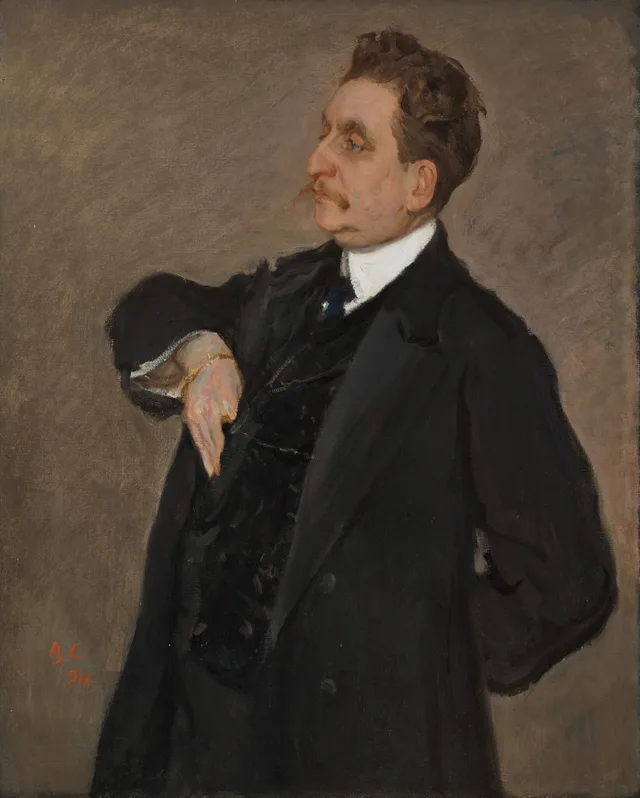
Vladimir Hirschman was a Moscow entrepreneur, patron and collector. In 1911 Serov portrayed him in profile with a hand at his waistcoat. The museum connects the gesture with his habit of repeatedly taking out his watch. One of Serov’s final portraits develops character through a recognisable movement as well as facial features.
The profile clearly defines forehead, nose and moustache. Looking aside, Hirschman seems engaged with someone beyond the canvas. Serov’s choice preserves a degree of distance, while the turned head and raised chin make the figure distinctive within a restrained palette.
The hand at the waistcoat is prominent and expressive. Serov turned a habitual movement into the principal bodily motif. Repeated attention to a watch could irritate companions; in the portrait it becomes a means of recognition. A private mannerism acquires the permanence usually associated with a famous face.
A stiff white collar sharply separates head from black clothing. Hirschman belonged to Moscow’s business elite, which participated actively in artistic life. Status appears through bearing and well-made dress without an elaborate office, factory or other external demonstration of commercial success.
Folds and highlights remain distinct across the black waistcoat and coat. Serov finds many variations within nearly monochrome clothing, giving hand and face particular prominence. A restrained portrait can be complex even with few bright colours and almost no setting.
The other arm is held behind his back, contributing to the unusual silhouette. Opposing arm movements make the pose slightly demonstrative. Hirschman was himself a connoisseur and collected antique furniture. Here the collector becomes the subject of another person’s selection, as the painter decides which features and habits will remain visible.
Hirschman owned around two hundred paintings and drawings by contemporary artists. After the Revolution his collection was nationalised; he moved to France and dealt in antiques. The portrait preserves him at the height of his Moscow position. Later history changes our reading of that assured pose, as the artistic world he supported underwent a different fate.
More works by Valentin Serov


- Medium
- Oil on canvas
- Collection
- State Tretyakov Gallery
- Dimensions
- 96 × 77.5 cm
- Accession number
- Инв.5587
Sources
Public-domain artwork. Digital reproduction from the State Tretyakov Gallery. Image licence