Turned Out into the Street
Mikhail Klodt · 1860
Explore the painting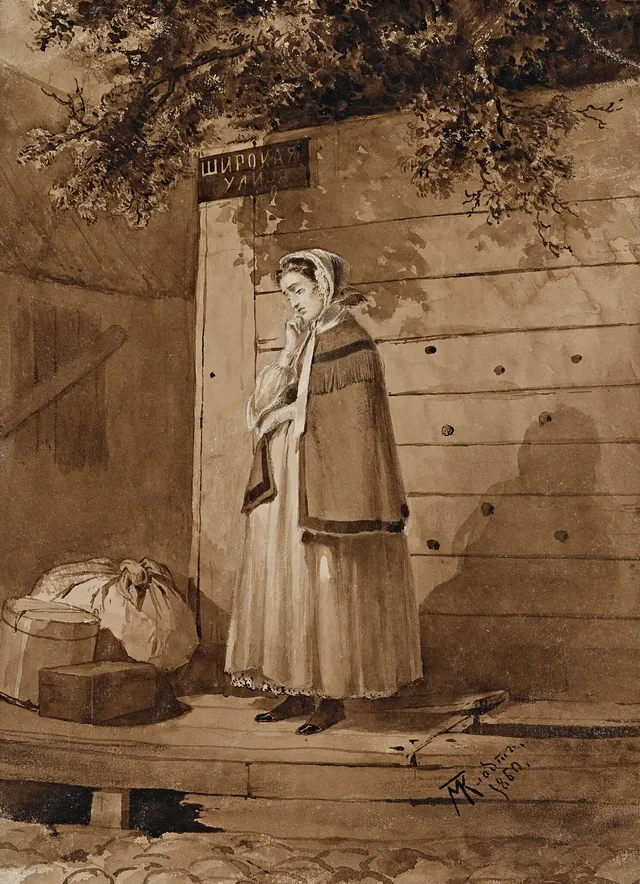
Mikhail Klodt made this sepia drawing in 1860 while living in France. The museum relates it to his Parisian model, abandoned by her lover during pregnancy. He transferred her story to a Russian setting. Private distress became a subject for viewers familiar with local streets, insecurity and the social condemnation faced by women.
The woman holds her scarf near her face and looks down. A small gesture becomes conspicuous within the still figure. Klodt chooses the aftermath of separation rather than a crowded confrontation: someone is left outside with the consequences of another person’s decision and must work out what to do next.
A bundle and two boxes sit at her feet, containing the possessions she could take. They explain the title more precisely than a sorrowful expression alone. Forced departure also means losing everyday security, and the limited luggage makes her vulnerability especially apparent.
The sign reads Wide Street. The museum essay draws attention to the bitter relationship: the street offers space, but no accessible home. Klodt makes written language part of the image’s narrative. We can compare the name’s openness with the blank wall and solitary figure beneath it.
A high fence occupies almost the entire background, separating the woman from a space that may contain a home and ordinary domestic life. Shadows of foliage and the figure cross its boards. Light makes the street detailed and visible, while the barrier remains closed. Exclusion acquires a straightforward spatial form.
The wooden pavement is damaged, with boards separating above a dark gap. Even the surface beneath her appears unreliable. Sepia unites face, clothing, timber and earth within a brown range. Tonal strength, transparent washes and denser lines retain detail without a broad palette.
Klodt arranges the image to invite sympathy and attention to the conditions of vulnerability. One model’s story becomes a social narrative carried across a border. Yet her voice reaches us through the artist’s choices. The drawing makes hardship visible while also revealing the author’s power to determine how another life is presented publicly.
- Medium
- Sepia on paper
- Collection
- State Tretyakov Gallery
- Dimensions
- 37.2 × 27 cm
- Accession number
- Инв.7107
Sources
Public-domain artwork. Digital reproduction from the State Tretyakov Gallery. Image licence