Peasant Girl
Filipp Malyavin · 1899
Explore the painting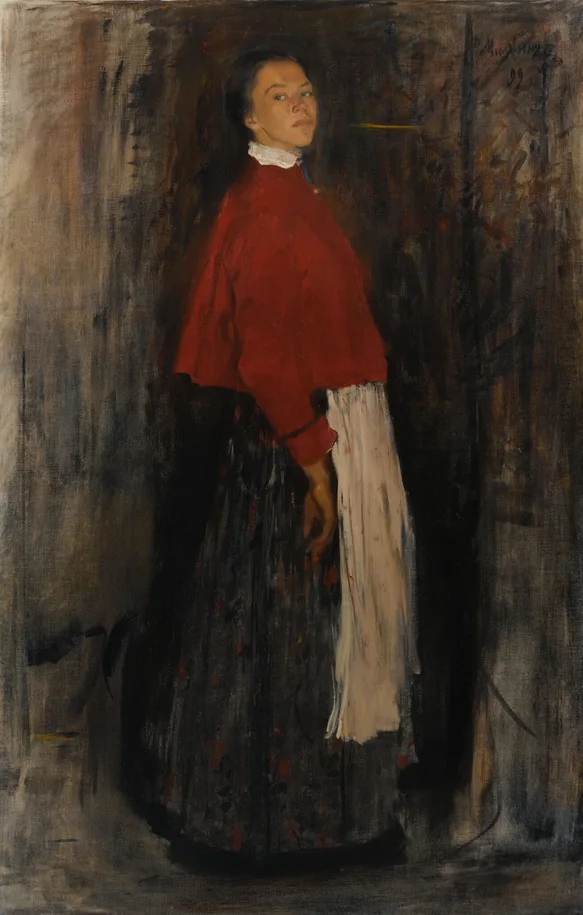
Filipp Malyavin painted his sister Praskovya in 1899. Born into a peasant family, he studied icon painting on Mount Athos before entering the Academy of Arts and Repin’s studio. This large portrait gives a village girl the scale associated with aristocratic sitters. Behind its simple title lies knowledge of both rural life and metropolitan artistic training.
The girl looks slightly downwards with her chin raised. A low viewpoint strengthens her independent presence. The museum account compares the pose with Repin’s portrait of Baroness Ikskul. That relationship shows how the expressive resources of formal portraiture can be applied to someone from another social position while retaining dignity and force.
The red blouse forms the most saturated area. Red gradually became one of Malyavin’s principal resources for depicting peasant life. Here it remains contained within a comparatively calm shape. It makes the figure stand out against darkness without requiring an elaborate interior or expensive jewellery to hold our attention.
The white apron runs down the figure and helps establish her height. Cool folds connect the red upper body with the dark skirt. A simple three-colour arrangement sustains the large canvas because each colour contains variations. The apron remains an everyday garment while performing an important compositional role.
The lowered hand appears relaxed and holds no agricultural implement. The sitter is not defined solely through labour. Malyavin allows her simply to stand before us. In a tradition that often represented peasants performing a task, this choice shifts attention between social role and individual presence.
Broad strokes move in different directions across the background. They describe no definite room but surround the sitter with an active painted surface. After studying with Repin, Malyavin increasingly explored this freedom of handling. Close up, we see the brushwork; from farther away it becomes darkness supporting the girl’s clear silhouette.
In 1900 the portrait appeared at the Paris World’s Fair alongside Malyavin’s Laughter. The Luxembourg Museum considered acquiring it, but it already belonged to the Tretyakov Gallery. The work crossed between artistic worlds. The painter’s relative from a village became the subject of international exhibition and a major European museum’s interest.
More works by Filipp Malyavin
- Medium
- Oil on canvas
- Collection
- State Tretyakov Gallery
- Dimensions
- 183 × 117 cm
- Accession number
- Инв.1571
Sources
Public-domain artwork. Digital reproduction from the State Tretyakov Gallery. Image licence