Bank Collapse
Vladimir Makovsky · 1881
Explore the painting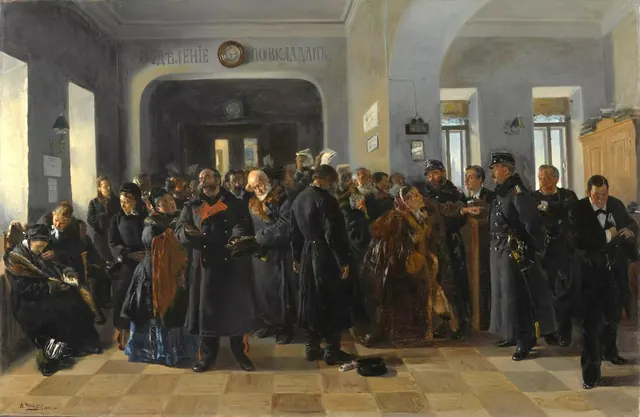
The painting’s story and details
Depositors crowd a banking hall. Some raise papers, others address employees, and a woman on the left has become unwell. Vladimir Makovsky painted Bank Collapse in 1881, turning a financial event into a crowded genre scene. A deposit relies on trust: money goes to an institution in exchange for a promise of repayment. Here that familiar connection has broken. Bodies, gestures and possessions reveal the consequences for people who had appeared secure.
On the left, a woman sits in a chair with her head drooping to one side. Another bends over and supports her. The crowd’s activity continues behind them. Window light picks out faces and clothing, making assistance visible within the agitation. The event is no longer only a matter of accounts. Financial loss has become a bodily condition requiring help there in the hall.
A man with orange-red lapels stands almost upright, one palm turned out. Around him people bend, turn and gesture. His bright coat trim attracts the eye, while the still pose holds it. Makovsky differentiates reactions through degrees of movement. A shared shock does not make the visitors identical; each retains a particular way of appearing before others.
Documents rise above the heads in the background. White sheets stand out against the dark passage. Their contents are illegible, but their role is clear: people use papers to press claims and attract attention. A document was meant to establish entitlement to money. Now it must be displayed above other people’s shoulders. Makovsky turns an abstract obligation into something that can be gripped and raised.
An elderly woman in a fur wrap extends her arm to the right. Her body leans forward and her face tilts up, carrying the movement beyond the group. Her clothing suggests means but offers no secure position now. People in dark official clothing stand nearby. Another boundary emerges within the crowd, between her expansive gesture and the restrained postures in this part of the hall.
The policeman on the right stands with his hands behind his back. His upright figure is extended by a sword almost reaching the floor. He occupies a distinct position before the counter, maintaining distance from the woman addressing that direction. His stillness is especially conspicuous among outstretched arms. A uniform can establish authority in a room without itself answering depositors’ demands for repayment.
A dark hat and rolled paper lie on the floor. A clear strip of parquet before the crowd makes them conspicuous. Normally carried, these objects have ended up underfoot. We did not witness them falling, but their position records a recent movement. Against the floor’s regular pattern, the disturbance of ordinary behaviour becomes particularly clear.
The sign above the arch reads “Deposit Department,” with a clock in the middle. High walls, bright windows and official notices preserve the appearance of a functioning institution. That makes the visitors’ reactions especially sharp. The building remains unchanged while confidence in its promises has disappeared. Outward order survives the loss of trust on which the place depended.
The painting appeared at the Wanderers exhibition in 1881. Stasov saw drama; other reviewers found the figures comic. That disagreement concerns our position before the crowd too. Expressive gestures may become an entertaining spectacle, or reveal how quickly a person with means becomes a petitioner. Makovsky leaves these possibilities together. A banking crisis tests our sympathy for people whose manners we may dislike.
Featured in tours
Russian life. Estate, city and village
How nineteenth-century painters depicted work, wealth, education and changes in everyday life.
More paintings to compare

Period, style and subject
- Movement
- Realism
- Genre
- Everyday life
- Medium
- Oil on canvas
- Collection
- State Tretyakov Gallery
- Dimensions
- 68.2 × 104.2 cm
- Accession number
- 607
Sources
Public domain. Reproduction from Wikimedia Commons. Image licence