The Card Players
Paul Cezanne · 1890–92
Explore the painting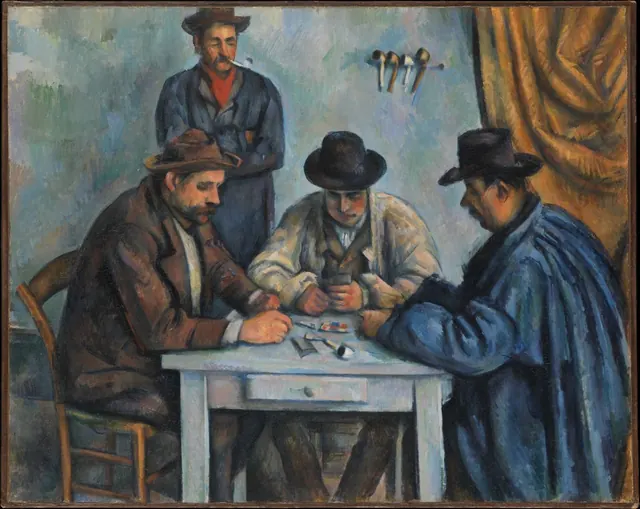
The painting’s story and details
In the early 1890s Cézanne spent several years working on his card-player series. Provençal farmworkers posed for him, including men from the family estate at Jas de Bouffan. This painting was assembled from individual sittings and studies. Three men sit at the table and a fourth watches behind them. Cézanne arranged the scene as a group portrait.
On the left, the man in brown leans towards the table. Elbow and forearm form a weighty support at its edge. Blue, pink and ochre strokes appear within the brown. The fabric feels substantial even as its colour shifts. Cézanne holds the figure with a firm contour while preserving many independent brush movements inside it.
The middle player lowers his head over the cards. His hat brim covers his forehead and his hands gather before his chest. A pale jacket separates him from darker neighbours and connects him with the tabletop. The three seated figures turn differently but converge on one small area. The game supplies a natural reason for this dense, enclosed arrangement.
The man on the right occupies an especially large area. His blue clothing extends in a broad band to the lower edge. Museum researchers compared him with a preparatory study and noted that the head had become smaller relative to the body. The revision makes shoulders and back more massive. Proportions changed alongside the arrangement of people, furniture and intervals.
The standing observer holds a pipe in his mouth, arms crossed. He adds height to the group and fills the interval above the left player. In 1891 the writer Paul Alexis visited Cézanne’s studio and found him painting a local peasant. This early testimony connects the series with actual sittings extending far beyond the moment of play depicted.
The pale table with its small drawer stands close to the front edge. Cards and a pipe lie on it. Its apparent stability emerged through revision: X-radiography revealed repeated changes to the table, chairs and figures. The visible simplicity conceals prolonged work in which even a small shift altered the distances between people.
Four pipes hang in a short row on the wall. Their angles differ, and their rounded bowls echo the dark shapes of hats. An everyday object enters the composition’s order alongside the people. Coloured strokes remain across the wall, giving even the open space behind the players a surface as active as their clothing.
The series comprises five canvases. In three versions Cézanne retained only two players and reduced the surroundings. Repeating the subject let him test how many people and objects a stable group required. Provençal workers, often shown labouring in painting, fill the canvas here at leisure, with the weight and presence that formal portraiture accorded its patrons.
Featured in tours
After Impressionism. Four different answers
Seurat, Cézanne, Van Gogh and Gauguin changed painting for different reasons.
More paintings to compare


Period, style and subject
- Movement
- Post-Impressionism
- Genre
- Everyday life
- Medium
- Oil on canvas
- Collection
- The Metropolitan Museum of Art
- Dimensions
- 65.4 × 81.9 cm
- Accession number
- 61.101.1
Sources
Image provided under CC0. Image licence