Still Life with Apples and a Pot of Primroses
Paul Cezanne · ca. 1890
Explore the painting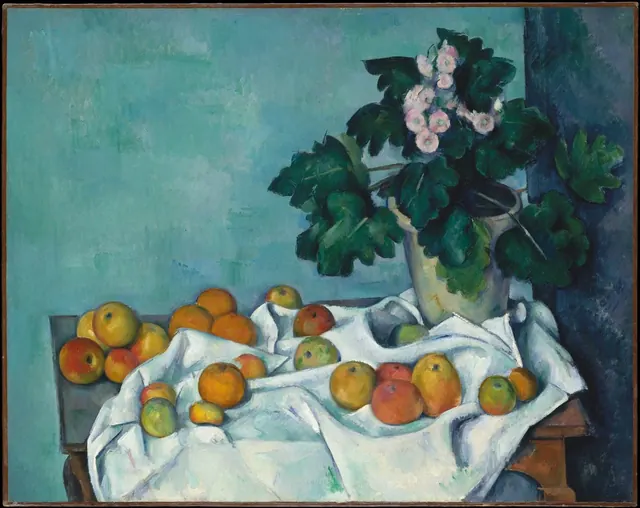
The painting’s story and details
Cézanne worked slowly on still lifes, so fresh flowers appeared rarely: they could wilt during the process. Around 1890 he placed a pot of primroses beside apples and white fabric. The tall plant occupies the right side, while scattered fruit fills the lower part. Cézanne arranged the round fruit, angular folds and dark foliage so that their contrasting shapes stand out beside one another.
Pale pink flowers rise above broad dark leaves. Their light rounded heads are painted with short touches, without describing every petal. The leaves look almost faceted as Cézanne divides green into areas of different density. The plant retains an organic irregularity, although its parts form a clear group against the bluish wall.
Foliage partly conceals the pale pot. We see its upper rim from above, while its side presents a broad surface. Yellow and blue areas make its volume tangible without smooth blending. Dark contours become especially noticeable beneath the leaves, anchoring the heavy vessel among lighter stems, cloth and flowers.
The white cloth gathers into folds with sharp peaks and deep hollows. Blue, green and lilac appear in the shadows. Its pale surface occupies much of the painting but is never uniformly white. It forms small depressions around the apples and rises between them, becoming a fully three-dimensional element of the arrangement.
Large yellow and red apples lie near the front edge. Their colour changes in separate patches, with rounded edges emphasised by dark lines. Narrow openings of cloth remain between the fruit. They are difficult to imagine as a random scatter: neighbouring forms support one another visually, even as the tilted tabletop creates a sense of instability.
The apples gather more tightly on the left, revealing the table edge behind them. Fabric almost hides the furniture, but a bowed leg and shaped apron remain visible on the right. The museum notes that this table appears in two other Cézanne still lifes from the 1890s. Reusing familiar furniture allowed different arrangements of cloth, fruit and open areas.
Claude Monet acquired the painting and kept it until his death in 1926. An enthusiastic gardener himself, he chose a rare Cézanne still life with a flowering plant. Such a purchase shows artists building collections and supporting their contemporaries’ work. These apples occupied the home of a painter whose own garden and pond supplied material for years of pictorial investigation.
Featured in tours
After Impressionism. Four different answers
Seurat, Cézanne, Van Gogh and Gauguin changed painting for different reasons.
Still life. The value and structure of things
Food, flowers, vessels, books and instruments in an owner’s life and a painter’s work.
More paintings to compare


Period, style and subject
- Movement
- Post-Impressionism
- Genre
- Still life
- Medium
- Oil on canvas
- Collection
- The Metropolitan Museum of Art
- Dimensions
- 73 × 92.4 cm
- Accession number
- 51.112.1
Sources
Image provided under CC0. Image licence