The Basket of Apples
Paul Cézanne · About 1893
Explore the painting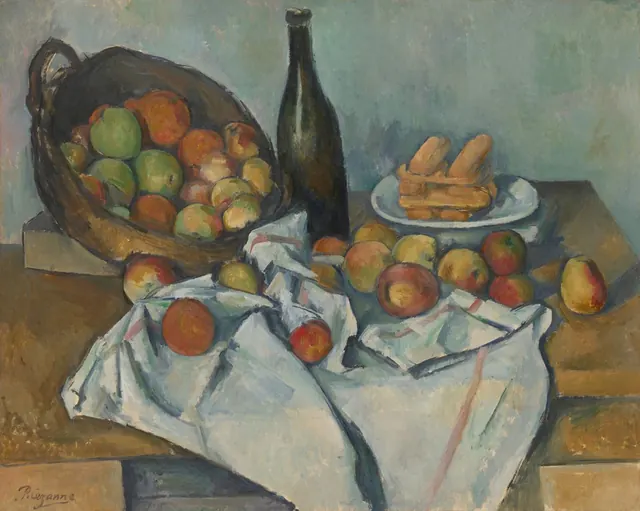
The painting’s story and details
A basket of fruit, a bottle and a plate of biscuits sit on a table. Yet the table edge runs at different heights on either side of the white cloth, the bottle leans, and the fruit seems ready to roll towards us. Paul Cézanne painted this still life around 1893. He had already exhibited with the Impressionists, but broad recognition came later. His paintings provoked arguments about artistic skill itself. Can an image be convincing when familiar objects break the rules of perspective?
A support beneath the basket makes it lean forward. We can see the fruit more clearly, while the arrangement looks less stable. The painter Louis Le Bail later recalled Cézanne wedging fruit with coins to achieve the positions he wanted. This account concerns his work in the late 1890s, several years after The Basket of Apples. It suggests how much preparation could lie behind an apparently casual arrangement.
The white cloth hides the middle of the table, but it cannot explain the mismatched edges. Extend them in your mind and they will not join into one straight line. Infrared imaging found horizontals at different levels in the preparatory drawing. Cézanne later reworked the table’s left side. According to the museum’s technical report, its unusual geometry was present early in the process. It cannot simply be explained as a mistake the artist happened to overlook at the end.
The dark bottle rises above the other objects and leans to the left. Cézanne returned to its neck and altered the outlines. His contemporaries noticed such tilts and asked him about them. Émile Bernard recalled him describing planes that overlap and straight lines that seem to fall. These recollections cannot diagnose Cézanne’s eyesight. They do show him discussing the gap between conventional correct drawing and what he noticed through prolonged looking.
Oblong biscuits are stacked on the plate. The museum’s 2026 catalogue identifies them as ladyfingers, or savoiardi. The upper ones appear at a different angle from those below, while the greyish background crosses parts of the plate’s right edge. The object’s boundary becomes intermittent. This movement of colour across an outline is called passage. Follow it and a perfectly clear division between object and surrounding space becomes elusive, even though the plate remains easy to recognize.
Red and yellow fruit rests among the cloth’s folds. Its white contains many shades, from cool blue to warm cream. In places the paint is thin enough to reveal the pale ground; the oranges have much thicker paint. Researchers traced Cézanne’s alternating additions to cloth and fruit. Their relationship developed gradually. Differences in colour, paint thickness and brush direction make us sense soft folds beside rounded fruit.
Near the right edge lies a fruit cautiously identified by researchers as a pear. Behind it, the tabletop’s tilt is visible again. Twentieth-century writers offered different explanations for these irregularities. Roger Fry related distortions to the artist’s arrangement of forms on the canvas. Anton Ehrenzweig turned to peripheral vision and prolonged fixation. These are competing theories, not an established account of how this particular painting was made. Both invite us to examine our own response: why can we recognize a table so readily when we cannot reconstruct its geometry?
Cézanne’s signature appears at the lower left. He left many of his works unsigned. By 1895, The Basket of Apples belonged to the dealer Ambroise Vollard, who organized the artist’s first solo exhibition. The critic Gustave Geffroy urged visitors to look beyond irregularities of perspective and balance. An exhibition allowed such features to be seen across several paintings. By comparing works, viewers could consider the artist’s sustained investigation.
In 1926, Frederic Clay Bartlett gave the painting to the Art Institute of Chicago. It became the collection’s first Cézanne. By then, his investigations mattered to a new generation of artists, including the Cubists. A still life of ordinary, readily available objects had become a place to reconsider how a painting works. Returning to the whole image reveals a curious result: tilted objects and mismatched edges do not prevent this table from seeming full of weighty, tangible things.
Featured in tours
After Impressionism. Four different answers
Seurat, Cézanne, Van Gogh and Gauguin changed painting for different reasons.
World classics. Altar, palace, exhibition
Familiar paintings and the people for whom they were made.
Still life. The value and structure of things
Food, flowers, vessels, books and instruments in an owner’s life and a painter’s work.
More paintings to compare


Period, style and subject
- Movement
- Post-Impressionism
- Genre
- Still life
- Medium
- Oil on canvas
- Collection
- Art Institute of Chicago
- Accession number
- 1926.252
Sources
Open-access Art Institute of Chicago reproduction, CC0. Image licence