Mount Sainte-Victoire
Paul Cezanne · c. 1904
Explore the painting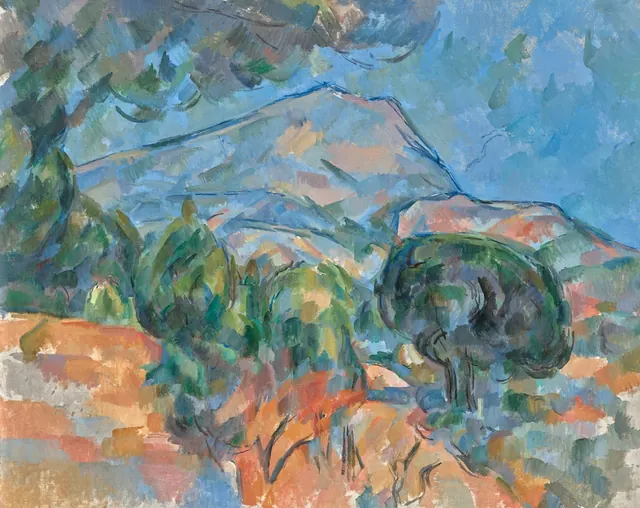
The painting’s story and details
Around 1904 Paul Cézanne painted Mount Sainte-Victoire near his native Aix-en-Provence once again. He returned to it throughout the last twenty years of his life, setting up his easel at different sites. This view came from a road running east from the town, with two pines in front. His work was already attracting younger artists, and a solo exhibition at the dealer Ambroise Vollard’s gallery in 1895 had widened his audience. Cézanne continued with a highly particular local problem: how to paint a familiar mountain and the air around it.
A blue line outlines the summit, doubling in places. Blue, pinkish and grey strokes lie within it. They indicate turns in the rocky surface while retaining their own rectangular shapes. We see a mountain and also notice it being assembled in paint. The contour does not enclose colour in a sealed silhouette: some hues continue into the sky. The massif acquires weight despite a shifting boundary that makes the division between object and background less self-evident.
A pine branch reaches across from the upper left above the summit. Its angle repeats the mountain slope, connecting a near tree with the distant massif. A great distance separates them, yet their lines almost meet on the canvas. Cézanne uses both relationships at once. The branch belongs to the foreground while also helping to organize the overall design. Our eyes can travel into the landscape, then return to the picture plane and notice forms separated in nature.
The pine on the right has a dark, rounded crown. Blue areas appear within the green, while a few sharp lines indicate trunk and branches. Individual needles are not visible. The tree’s volume rests on the adjacency of warm and cool patches, dense and lighter areas. The same colours appear in mountain and sky. Repeated colour connects three different materials—rock, foliage and air—within one pictorial space.
Orange and ochre earth fills the lower canvas. Blue patches among the warm colours repeat the distant mountain. Cézanne took an interest in the structure of this landscape. His friend Antoine-Fortuné Marion studied geology and palaeontology, and they went out painting together. On the canvas, combinations of colour and the shapes of brushstrokes convey the slopes’ mass and structure.
The sky is painted with strokes as visible as those of the earth. Pale intervals remain between touches near the edges and lower down. The image does not conceal its construction beneath a smooth finish. We have to compare neighbouring areas and complete the landscape’s continuity. This method has a precision of its own: it conveys relationships between colours and volumes without closing every outline.
After Cézanne’s death, exhibitions in Paris in 1907 strengthened his influence. Picasso and Braque developed ways of constructing form for which his painting was an important source. Before this mountain, it is also worth retaining his original task: close study of familiar nature. What opened a route towards Cubism for the next generation grew here from repeated returns to one place. Experiment in representation emerged through sustained observation.
Featured in tours
After Impressionism. Four different answers
Seurat, Cézanne, Van Gogh and Gauguin changed painting for different reasons.
How painting changed in the early twentieth century
Colour, the human figure and early experiments in abstraction.
More paintings to compare


Period, style and subject
- Movement
- Post-Impressionism
- Genre
- Landscape
- Medium
- oil on fabric
- Collection
- Cleveland Museum of Art
- Dimensions
- Unframed, 72.2 × 92.4 cm
- Accession number
- 1958.21
Sources
Image provided under CC0. Image licence