The Third-Class Carriage
Honoré Daumier · 1864
Explore the painting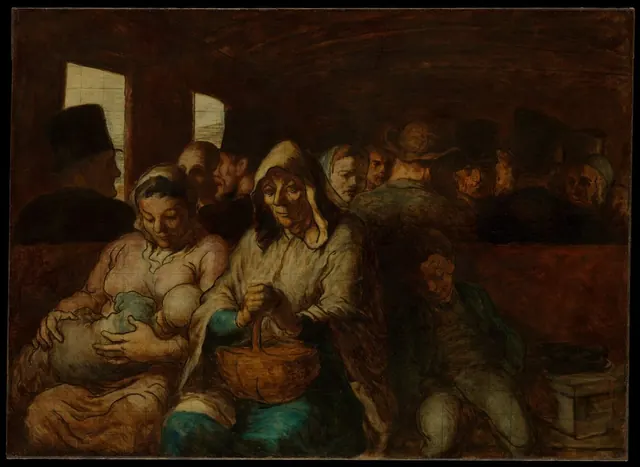
The painting’s story and details
Two women and two children sit before us on a hard bench. Behind them, closely packed rows fill the carriage. Daumier worked on this subject in the 1860s, as railways changed journeys between city and countryside. Conditions depended on the fare. Third-class passengers occupied shared wooden benches, brought close to strangers’ fatigue, conversations and concerns.
The younger woman supports an infant with both hands. The baby rests against her breast, though fabric covers her body. The picture shows closeness and care while leaving the passengers’ relationships open. Daumier uses strong, fluid lines around fingers, sleeves and the infant’s head. These contours hold the figures together even where colour is thinly applied.
In 2018 historian George Sussman proposed identifying the younger woman as a wet nurse and her older companion as a hiring intermediary. Parisian infants were often sent to rural women for nursing, and railways facilitated these journeys. Clothing, pose and Daumier’s other images of wet nurses support the proposal. It remains an interpretation, opening the scene to a reading through women’s paid work.
The older woman holds a basket on her knees, her hands folded above its handle. A pale hood surrounds her deeply lined face. Her upright posture and broad knees give the figure weight. Among people turned in different directions, she remains clearly visible. Daumier makes a modestly dressed traveller the compositional centre of a crowded scene.
The boy on the right sleeps with his head tilted to one side. His hands rest on his knees; a tied box stands nearby with a dark cap on its lid. Sleep occupies the same cramped space where others keep possessions and care for an infant. His outline almost merges with the brown bench back, making him less immediately distinct than the illuminated women.
Top hats, bonnets, profiles and the backs of heads repeat behind them. People sit close together, each turned differently. Light enters through the left windows. The passing landscape is barely indicated, while the carriage’s arrangement makes us face our fellow travellers. The viewer occupies a seat on the opposite bench.
Fine intersecting lines remain across windows and clothing. This grid assisted the transfer of the composition; the canvas was left unfinished. Daumier returned to the group in several versions. William Walters commissioned a related watercolour through his agent in 1864. The sequence of the watercolour and two large canvases remains disputed. The grid records a working process involving repeated designs.
Daumier earned his living through cartoons for the satirical press. In 1832 he was imprisoned for depicting King Louis-Philippe. His drawings mocked government, the bourgeoisie and professional groups. This carriage directs attention towards people who seldom became subjects of major paintings. His knowledge of social life as a caricaturist helped place them alongside art’s more customary protagonists.
More paintings to compare

Period, style and subject
- Movement
- Realism
- Genre
- Everyday life
- Medium
- Oil on canvas
- Collection
- The Metropolitan Museum of Art
- Dimensions
- 65.4 × 90.2 cm
- Accession number
- 29.100.129
Sources
Image provided under CC0. Image licence