The Zemstvo Dines
Grigory Myasoedov · 1872
Explore the painting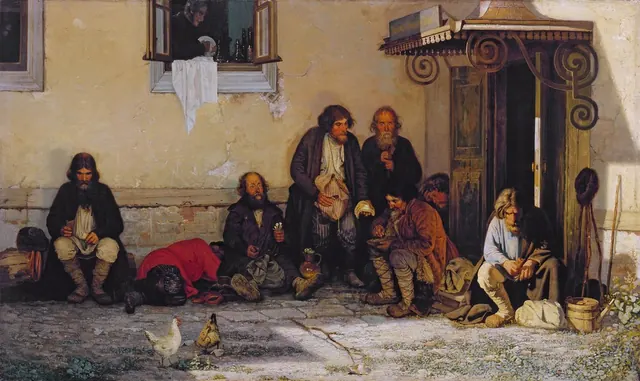
The painting’s story and details
Peasants eat outside the district zemstvo office. They have come to participate in local self-government established by the reform of 1864. Zemstvos handled economic, educational and other local matters. Grigory Myasoedov painted this in 1872, when the new institution could already be judged through everyday practice. He chose the lunch break. The placement of people and food reveals relationships within the institution while its meeting is paused.
A person wipes a plate in the open window, with a white towel hanging over the sill. Bottles and dishes stand behind him. The diners inside are absent from view, yet the service makes their presence intelligible. Above the peasants on the ground appears another arrangement for the same break. A few objects at the window establish that the outdoor meal is more than a chance stop by passers-by.
The office sign hangs above the entrance. Beneath it is an elaborate canopy with scrolls, beside crumbling plaster. The institution’s name gives the small scene a public significance. People engaged in the same business spend their break in different conditions. Social rank becomes visible outside the formal meeting. The painting invites an assessment of local self-government through its everyday arrangements.
A man in a red shirt lies along the wall with his face turned away. His extended body interrupts the row of seated figures. Bright cloth holds our attention even though he remains largely hidden. Varied postures prevent the group from becoming a uniform line. One rests while others eat or hold belongings on their knees. Myasoedov preserves differences between people even in a shared situation that requires each to find a place beside the wall.
The seated man near the centre holds a bunch of spring onions. Bags lie nearby and a jug stands at his feet. Objects are arranged directly on the ground, making each action require bending or holding food by hand. He looks ahead. His face is detailed enough to remain an individual within the group.
On the right, a man bends over his bread and sprinkles salt onto it. The small movement of his fingers stands out against a broad pale wall. Food remains in his hands; there is no table. His action and the plate being wiped at the window create a precise comparison of circumstances. There is no argument. Viewers assess inequality by relating two simultaneous activities.
Two hens walk in front of the men on the same uneven ground as their travelling belongings. The pale wall almost closes off depth and gathers the figures into a narrow strip. Our eyes cannot wander into a distant landscape; they travel along the people, from window to door and back.
At the second Wanderers exhibition in 1872, critics disagreed. Some saw social force, while others found the action too ordinary. Its ordinariness matters. Peasant participation in a new institution had not removed differences visible at lunch. Myasoedov tests a major reform through a small incident. A shared name above the doorway and separate conditions for its participants become parts of one question about equality.
Featured in tours
Russian life. Estate, city and village
How nineteenth-century painters depicted work, wealth, education and changes in everyday life.
More paintings to compare

Period, style and subject
- Movement
- Realism
- Genre
- Everyday life
- Medium
- Oil on canvas
- Collection
- State Tretyakov Gallery
- Dimensions
- 75 × 125.5 cm
- Accession number
- 639
Sources
Public domain. Reproduction from Wikimedia Commons. Image licence