Lady Elizabeth Delmé and Her Children
Joshua Reynolds · 1777-1779
Explore the painting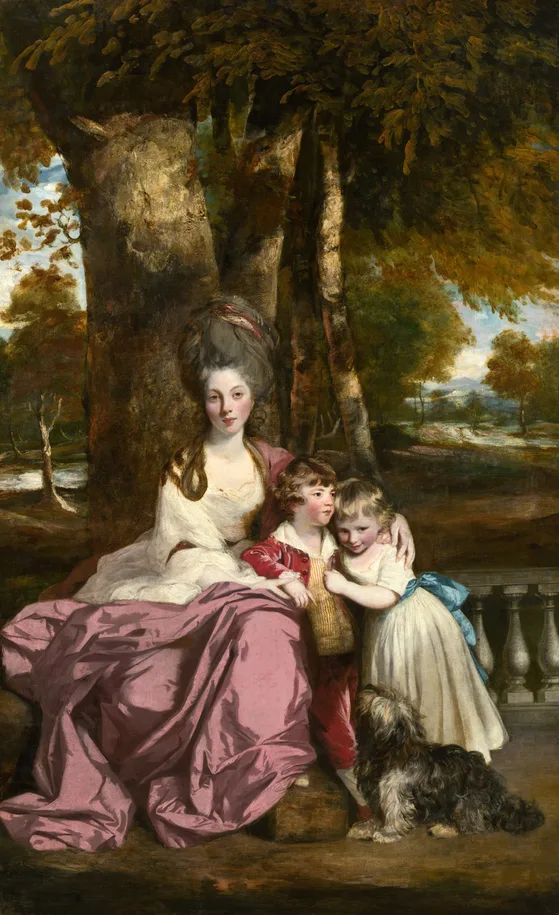
Lady Elizabeth Delmé sits with her son and daughter while a dog rests at their feet. Reynolds worked on the portrait in 1777–1779. His images of British aristocracy combined contemporary fashion with the authority of old masters. This family group recalls Raphael’s Madonnas, giving domestic affection the dignity associated with grand historical painting.
The mother looks beyond the picture while the children lean against her. Their heads descend in a line and the group forms a stable triangle. This arrangement holds several figures together while recalling a respected artistic tradition. The sitter enters a composition whose cultural prestige would have been recognizable.
The mother’s and children’s hands intertwine near her lap. A connected gesture makes their closeness visible without further explanation. Yet the poses are carefully coordinated for viewing. Reynolds constructs a public image of motherhood, presenting affection in a form suited to a grand house and its family memory.
A broad pink drapery surrounds Lady Delmé’s knees. Large folds enlarge the figure and give her seated pose monumentality. Impractical for an ordinary household activity, the abundance of fabric serves a pictorial purpose. Reynolds asks viewers to see a contemporary woman on the elevated scale of a figure in an old-master painting.
The daughter grips her brother’s clothing with her head slightly inclined. His open collar and her light dress with blue sash distinguish them, while light unites their faces. These details preserve a particular family within the formal scheme. Small irregularities of movement keep the children from resembling miniature statues.
A small Skye terrier looks up at the family. Freer handling describes its fur, and its dark shape anchors the lower right. The dog introduces familiar domestic company into the elevated setting. A stone balustrade separates the group from the landscape: nature is available to their gaze from a cultivated terrace.
The portrait offers a particular vision of high society: prosperous, cultivated, and bound by family affection. Its persuasiveness depends on actual faces and a language inherited from Renaissance masters. Both can be considered together. The picture preserves closeness while showing how artistic tradition helped affirm the position of those able to commission such work.
More works by Joshua Reynolds
- Medium
- oil on canvas
- Collection
- National Gallery of Art, Washington
- Dimensions
- 238.4 × 147.2 cm
- Accession number
- 1937.1.95
Sources
Museum reproduction. Public domain, NGA Open Access. Image licence