Lady Caroline Howard
Joshua Reynolds · 1778
Explore the painting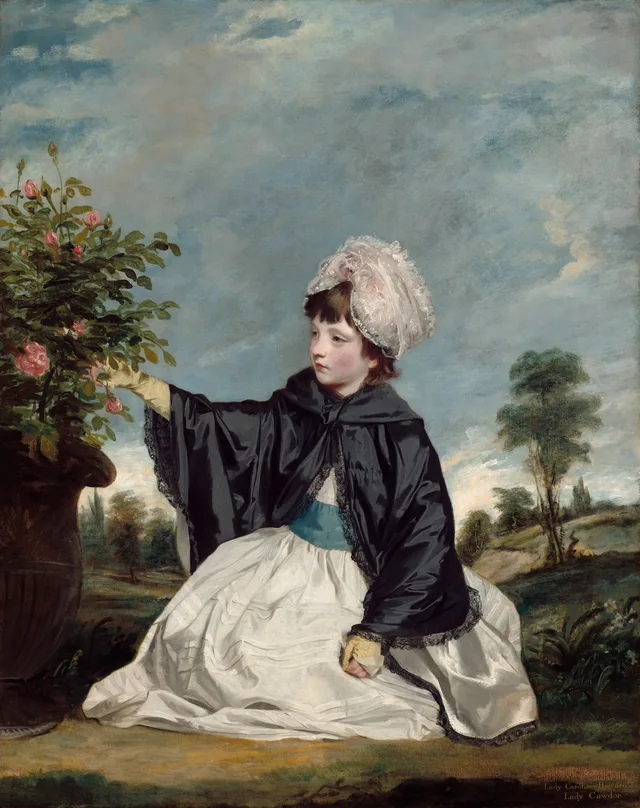
Caroline Howard was seven when Reynolds painted her in 1778. Her father, the fifth Earl of Carlisle, commissioned the portrait. She appears outdoors beside a rosebush in a large urn. Clothes, pose, and setting suggest how her family wished to remember her, while her intent expression complicates the carefully arranged scene.
Her head turns toward the roses and her eyes lower. She neither smiles at viewers nor seeks their attention. Her father described Caroline as determined and strong-minded. That family account cautions against reducing a serious face to sadness. Character remains present within the expectations surrounding a charming child’s portrait.
Her right hand touches a flower. Roses in European art could refer to Venus, beauty, and love. NGA scholars consider a possible allusion to qualities expected of the future woman. This does not erase a child’s immediate interest in a plant. A single gesture can accommodate childhood activity and an adult-designed program.
The other hand rests near her knees, more tightly closed. The contrast makes the pose less untroubled: one hand reaches outward while the other stays close to the body. Reynolds retains this small tension within a stable design. The child occupies a position of her own in a scene arranged for family portraiture.
A black cape catches the light and a lace bonnet frames the face. The white skirt spreads broadly across the ground. Expensive clothing nearly conceals the small body and identifies an aristocratic upbringing. A natural outdoor setting does not remove social distinctions; it helps present privileged childhood attractively.
The rosebush grows in a tall ornamental urn rather than in open ground. Nature has been selected, planted, and incorporated into human surroundings. A broad landscape stretches behind Caroline, while immediately beside her stands its cultivated form. This arrangement suits a family commission in which the freedom of childhood also has boundaries.
The painting remained with the Howard family into the twentieth century. For them it represented a particular daughter and relative; in a museum it also documents aristocratic upbringing and self-presentation. Those meanings coexist. A child touches a rose while the surrounding adult world associates that gesture with beauty, position, and a future life.
More works by Joshua Reynolds
- Medium
- oil on canvas
- Collection
- National Gallery of Art, Washington
- Dimensions
- 143 × 113 cm
- Accession number
- 1937.1.106
Sources
Museum reproduction. Public domain, NGA Open Access. Image licence