The Attentive Nurse
Jean Siméon Chardin · 1747
Explore the painting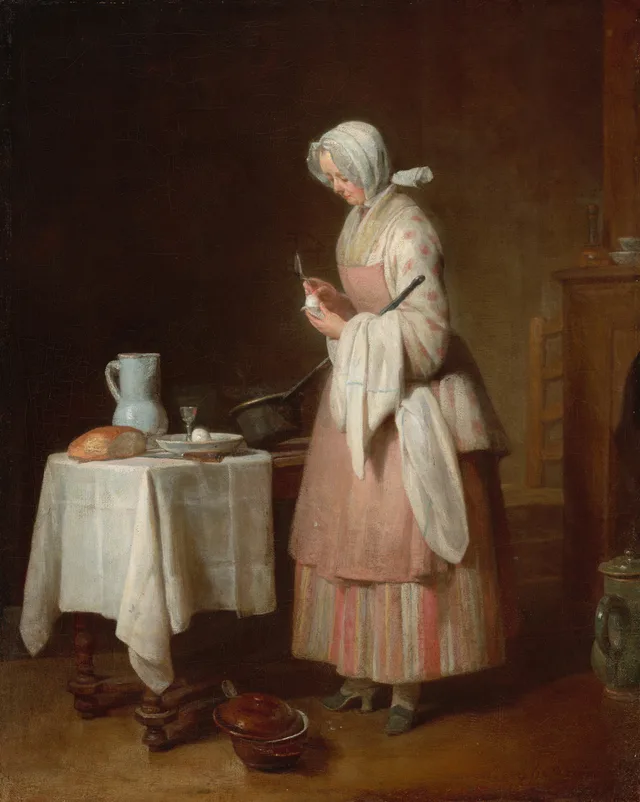
A woman prepares a simple meal beside a small table. At the Paris Salon of 1747 the painting’s title referred to food for a convalescent. Its meaning therefore extends beyond a kitchen task. The patient remains unseen. Chardin shows care through preparation and gives full attention to the person doing the work.
She holds a spoon and an egg with her head attentively lowered. Hands close together make the small action legible. Preparing suitable food, checking it, and serving it on time form a concrete kind of participation in another person’s life. Painting gives that work enough importance to sustain a picture of its own.
Pitcher, bowl, egg cup, bread, and knife occupy the table. Modest objects each have a purpose. Chardin brought extensive still-life experience to domestic scenes. Here things connect with action, making the setting intelligible through their readiness for use.
She braces the pan’s long handle in the crook of one arm, with a cloth draped over the forearm. Her pose reveals familiarity with managing several things at once. Such practical skill is easily overlooked in life. Space around the hands lets viewers follow how the movement is organized.
Pink apron and striped skirt use closely related, soft colors. The light fabric lacks courtly satin’s sheen but retains weight and texture. Chardin does not require luxurious costume for sophisticated color. Ordinary clothing receives the sustained attention given to expensive textiles in formal portraiture.
A covered pot stands at her feet, with the hearth farther away. Objects occupy successive levels: floor, table, hands, mantel. This arrangement makes the small room legible and inhabited. The darker setting keeps practical things available without distracting from the task. Order grows from use rather than displayed wealth.
Prince Joseph Wenzel of Liechtenstein acquired the painting. A scene of practical care thus appealed to an aristocratic collector, offering appreciation of work he would likely delegate to others. That social distance adds complexity. Chardin nevertheless gives the working woman the central role, rather than reducing her activity to an incidental detail of someone else’s comfort.
Featured in tours
Domestic life. Leisure and care
Sixteen paintings about reading, music, children and the work that makes domestic comfort possible.
More works by Jean Siméon Chardin
- Medium
- oil on canvas
- Collection
- National Gallery of Art, Washington
- Dimensions
- 46.2 × 37 cm
- Accession number
- 1952.5.37
Sources
Museum reproduction. Public domain, NGA Open Access. Image licence