The White Tablecloth
Jean Siméon Chardin · c. 1731–32
Explore the painting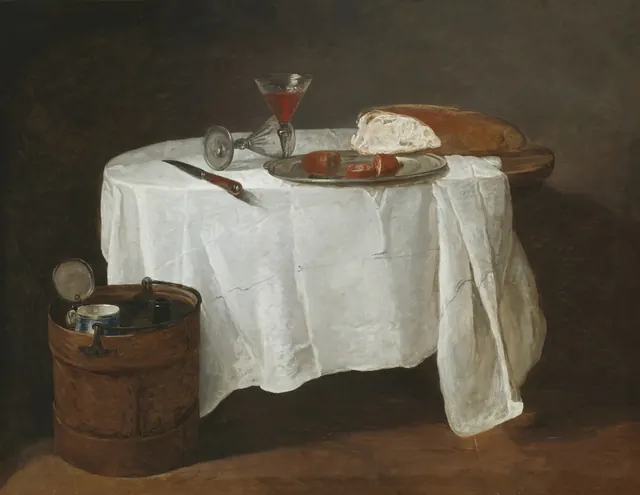
The painting’s story and details
This painted table originally covered a fireplace opening. Chardin painted the still life around 1731–1732 for a fire screen covering an unused hearth. Positioned close to the floor, the image was intended to deceive the eye and extend the room. Its unusual format belongs to that domestic purpose.
A white cloth occupies much of the table. Its folds gather shadows and lead towards the objects remaining after a meal. Pale fabric makes an everyday arrangement visible even with the screen positioned low down. The lighting connects things on a surface that seems within arm’s reach.
The standing wineglass is thin and transparent. Another glass lies nearby at a different angle. Glass can be described through edges, highlights and slight changes in colour. The dark background makes vessels visible that could almost disappear against a pale wall.
A knife handle projects beyond the table’s edge. The museum traces this device to seventeenth-century Dutch and Flemish still lifes. The object seems to enter the room. On a fire screen, that shortening of distance served the particularly concrete purpose of suggesting a real table.
A cut sausage rests on a plate. Food remains indicate a meal already taken, although nobody appears. Chardin selects objects according to their related uses. The cut sausage, bread and used tableware suggest a meal that has just ended.
Bread retains a substantial crust and pale cut surface. In 1728, Chardin entered the Royal Academy as a painter of animals and fruit. Still life occupied a low position in the academic hierarchy of genres. His professional recognition depended on mastery in depicting precisely such modest things.
A wooden bucket holding vessels stands below. Its hoops, an earthenware container and a reflective lid bring different materials together. The objects continue below the tabletop. For a screen near floor level, this lower group connected the image to the room’s actual height.
The overturned glass adds a small disruption of order. The museum relates this motif to northern European still-life traditions. Beside the projecting knife and food remains, it suggests a recently vacated table. The transparent vessel becomes particularly visible through the dark interval between it and the cloth.
Today the canvas belongs to a museum and is viewed as an independent artwork. Its original audience encountered it among furniture, at another height and under different lighting. Recovering its function as a fire screen explains the insistent proximity of the knife, cloth and tableware.
Featured in tours
Still life. The value and structure of things
Food, flowers, vessels, books and instruments in an owner’s life and a painter’s work.
More paintings to compare
Period, style and subject
- Movement
- European painting
- Genre
- Still life
- Medium
- Oil on canvas
- Collection
- Art Institute of Chicago
- Dimensions
- 96.8 × 123.5 cm
- Accession number
- 1944.699
Sources
Image provided under CC0. Image licence
Adapted and translated from Art Institute of Chicago materials. · Text licence