The House of Cards
Jean Siméon Chardin · probably 1737
Explore the painting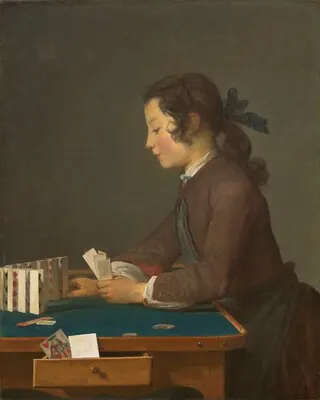
The painting’s story and details
A boy sets folded cards on a table. They form a low, curving row. Chardin probably painted this version in 1737 and showed it at the Paris Salon. He returned to the subject repeatedly; four versions survive. A simple activity offered renewed opportunities to explore attention, careful hand movements and a person’s presence among objects.
The face is in profile, its eyelids lowered. The boy looks at the table, barely attending to the space around him. A pink cheek stands out among browns and greenish tones. Chardin leaves ample empty background around the head, making its slight inclination especially significant. Attention becomes visible through a gaze and a posture maintained for a precise action.
Each card is folded in half and stands on two edges. Light differentiates the white paper, while red and black suits appear on the faces. The row recedes at a slight angle. Its rhythm of pale strips invites us to regard the construction as a still life in its own right. A careless movement could disturb its order, giving the motionless scene tension.
One hand brings a card towards the row; the other holds several prepared folds. A small sequence of work emerges between the reserve and the construction. Chardin carefully describes an activity needing neither an audience nor a prize. A few coins lie nearby, yet the boy’s attention stays on what he is building. Gaming materials are being used for something quite different from an ordinary card game.
The drawer projects towards us, with two more cards protruding from it. A jack of hearts faces the viewer while the boy appears only in profile. That small difference of direction enlivens the lower part of the picture. The open drawer also shortens our distance from the table. We seem to have approached the workspace while its occupant carries on.
The dark wall contains almost no detail. Brown clothing approaches its colour, while white cuffs connect the hands with the cards. Soft transitions prevent the figure from looking cut out against the background. Person and objects share a single quiet space.
By 1774 the painting belonged to Catherine II’s collection. In March 1931 Andrew Mellon acquired it during Soviet sales from the Hermitage; it later became part of the National Gallery’s founding collection. An unobtrusive domestic activity proved valuable to an imperial collection and an American museum.
Featured in tours
For children. Everyday life before us
Homes, school, trains and games in twelve paintings. For ages 8–12 and adults.
More paintings to compare
Period, style and subject
- Movement
- Realism
- Genre
- Everyday life
- Medium
- oil on canvas
- Collection
- National Gallery of Art, Washington
- Dimensions
- Overall, 82.2 × 66 cm
- Accession number
- 1937.1.90
Sources
Reproduction of a public-domain artwork. Image licence