Soap Bubbles
Jean Siméon Chardin · probably 1733/1734
Explore the painting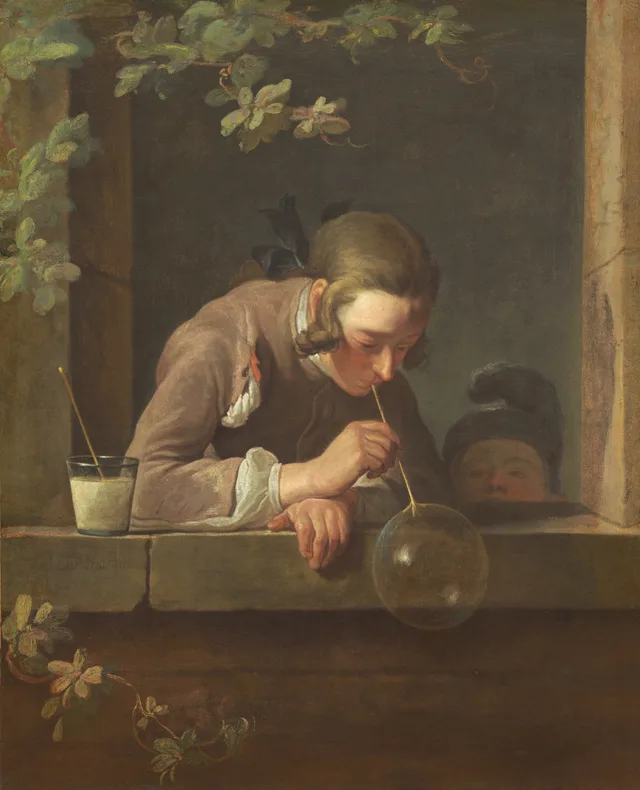
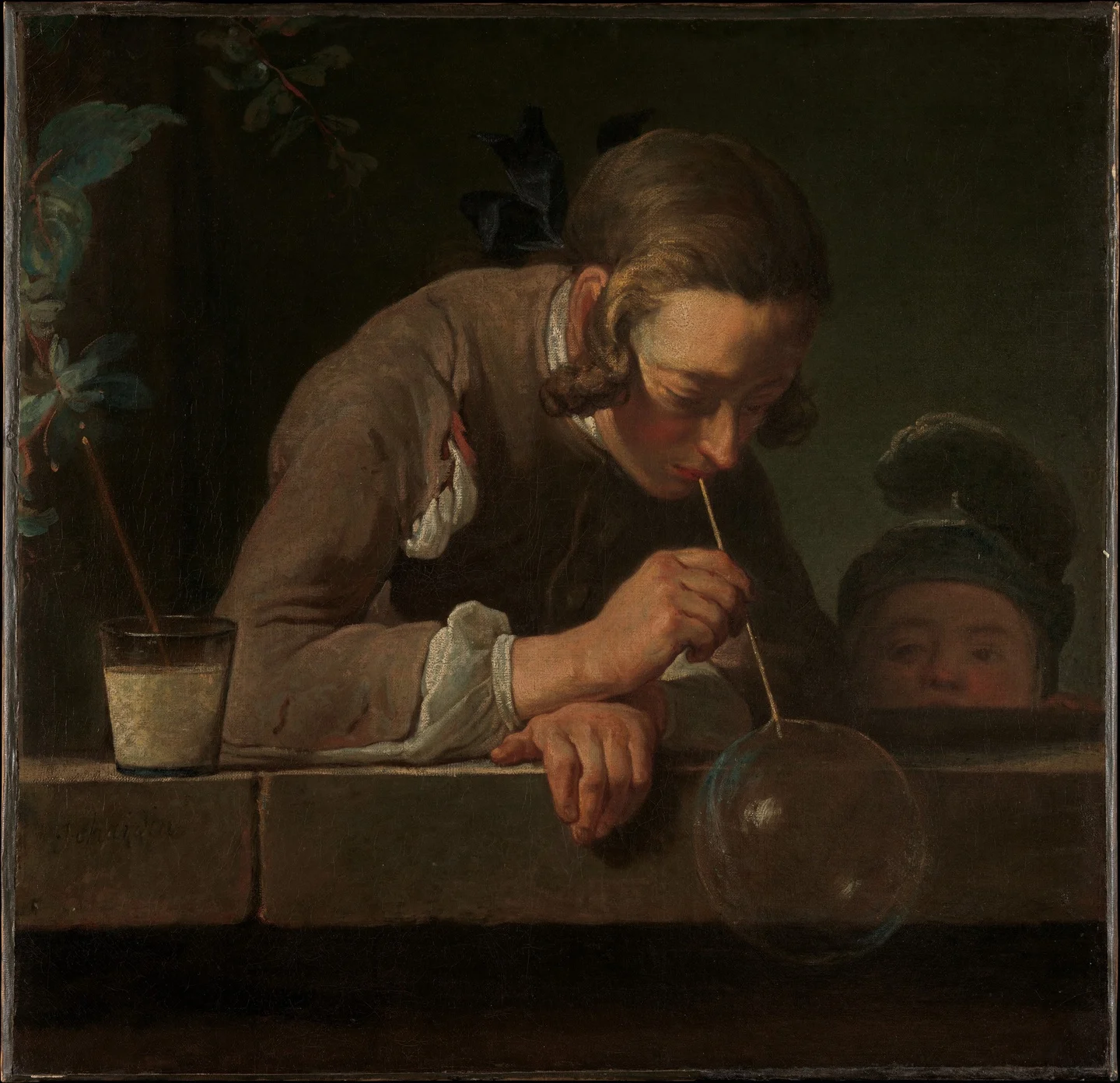
A youth blows a bubble while a small child watches from behind the ledge. Chardin probably painted this version in 1733–1734. Bubbles had long suggested the fragility of human life in European art. Yet his attention to the activity also invites another reading: an experiment requiring patience, precision, and concentration on something almost invisible.
A transparent bubble hangs from the straw. A few highlights and a thin boundary describe it while leaving the dark background visible. Chardin does not need to fill the shape with color to paint transparency. The technical problem echoes the activity: both youth and painter work with a delicate surface easily lost.
The head bends toward the bubble. Mouth and one hand control the straw while the other rests on stone. The whole pose serves a small action. Concentration becomes visible through the body’s coordination. Within the painting, this activity receives the attention another genre might reserve for a consequential historical deed.
The younger child barely rises above the ledge. Only the upper face and cap appear, but the gaze connects him to the action. He learns by watching. Alongside him we wait to see what happens to the bubble. Shared attention allows the painting to address curiosity without a classroom, teacher, or written rule.
A glass of soapy water and a spare straw rest on the ledge. These simple objects receive the same serious attention as the face. Chardin’s extensive work in still life trained him to build importance through light, color, and neighboring forms. Those skills establish a convincing setting around the experiment.
The forearms rest on a broad stone ledge, whose weight contrasts with the bubble’s lightness. The rectangular window limits the scene while foliage softens its edges. The composition gives the viewer a stable observation point from which to study an action lasting only seconds in life.
The traditional association with transience remains available, but the painting also gives space to absorbed activity and shared observation. It rewards comparison with formal portraits of the same period. Where clothing and status often establish a person’s importance, this image holds attention through the capacity to become engrossed in a simple experiment.
Featured in tours
Domestic life. Leisure and care
Sixteen paintings about reading, music, children and the work that makes domestic comfort possible.
More works by Jean Siméon Chardin
- Medium
- oil on canvas
- Collection
- National Gallery of Art, Washington
- Dimensions
- 93 × 74.6 cm
- Accession number
- 1942.5.1
Sources
Museum reproduction. Public domain, NGA Open Access. Image licence