Kitchen Utensils with Leeks, Fish, and Eggs
Jean Siméon Chardin · c. 1734
Explore the painting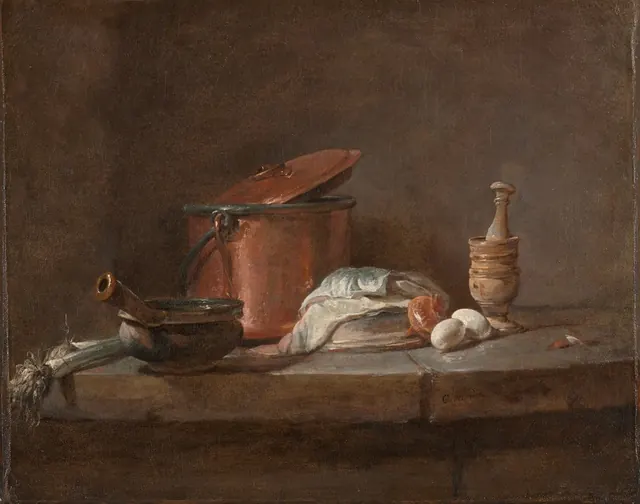
The painting’s story and details
Around 1734 Jean-Siméon Chardin arranged a pot, mortar and kitchen ingredients on a stone ledge. He was already a member of the Royal Academy, admitted in 1728 for his skill in still life. This genre ranked lowest in the academic hierarchy, below history painting and portraiture. His success with small canvases of everyday utensils is therefore significant. The choice of objects itself raised a question about what could sustain attention in painting.
The copper pot rises above the other objects. Its lid rests at an angle, opening a dark gap, and its handle is lowered at the side. The reddish metal reflects light unevenly, with subdued patches beside brighter areas. These differences give the rounded wall volume. An almost empty brown background lies behind it. Such a setting lets us examine an ordinary pot at length, noticing a surface usually glanced at while cooking.
The dark vessel on the left partly conceals the pot. Its hollow handle points left and slightly towards us. Leeks lie behind it, their roots hanging over the ledge. Overlapping forms establish the objects’ order. The movement from depth to foreground is especially clear: the roots almost reach into our space. Chardin creates proximity without depicting an entire kitchen. A stone edge and a few objects placed in front of one another are enough.
The fish lies beneath a pale cloth, beside a reddish onion. Grey, bluish and warm strokes describe the folds; together they make the cloth appear white. This distinguishes an object’s colour from the pigments used to represent it. Chardin relates the cloth’s hues to metal and stone, maintaining a common light. We distinguish the surfaces while recognizing the same light falling across them.
Two eggs lie in front of the onion and mortar. They are small, but their pale surfaces immediately stand out among brown and grey tones. One partly overlaps the other, with a fine shadow separating their volumes. After the large pot, they provide a different scale. Their small curves support the group’s rhythm and keep the pale cloth from becoming the sole centre of attention. Even a slight shift would change the composition’s balance.
The mortar and pestle complete the group on the right. Its turned rings relate to the curves of pot and eggs, while its upright form answers the angled lid. Chardin often reused objects, changing their positions and the contents of a still life. The arrangement is carefully selected despite appearing casual. Repetition allowed him to test combinations: how much space to leave empty, which object should overlap another, and where the lightest patch should fall.
Despite still life’s low rank, the Academy offered Chardin recognition and work. He remained an active member and later held administrative positions. His career shows that an official hierarchy of genres could differ from the recognition of artistic skill. No grand event establishes this painting’s value in advance. Relationships of colour, light and scale sustain our attention. The kitchen objects withstand that scrutiny in their own right.
Featured in tours
Still life. The value and structure of things
Food, flowers, vessels, books and instruments in an owner’s life and a painter’s work.
More paintings to compare
Period, style and subject
- Movement
- Realism
- Genre
- Still life
- Medium
- oil on canvas
- Collection
- Cleveland Museum of Art
- Dimensions
- Unframed, 32.2 × 40.7 cm
- Accession number
- 1980.37
Sources
Image provided under CC0. Image licence