The Kitchen Maid
Jean Siméon Chardin · 1738
Explore the painting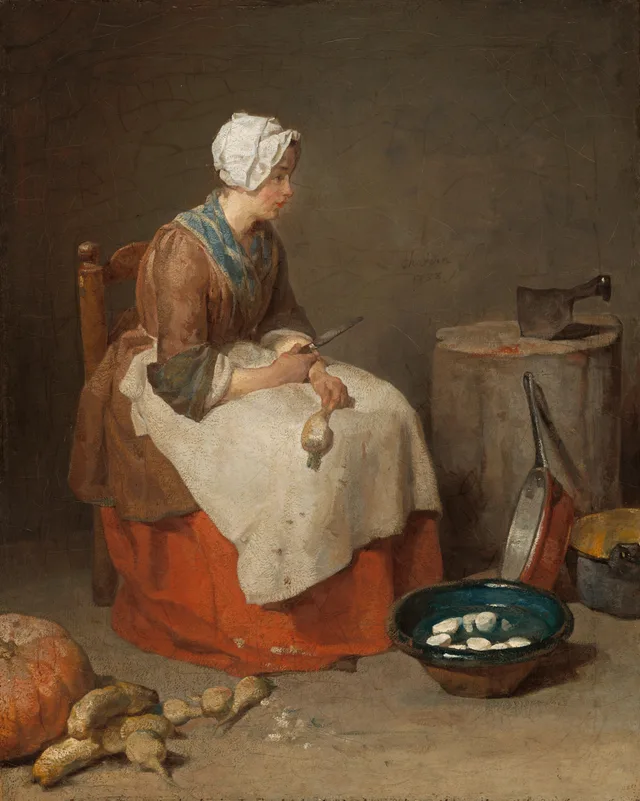
A woman pauses with a knife and a root vegetable in her hands. Chardin painted The Kitchen Maid in 1738. Kitchen equipment surrounds her, but he chooses a moment when work briefly stops. We encounter a person whose attention can move beyond her duty even while that duty remains.
Her head turns right, looking past the viewer, while the hands remain in her lap. The pause emerges through a separation between gaze and task. Chardin supplies no event explaining the distraction. Attention stays with a familiar condition of working life: the body remains in place while thought can move elsewhere.
Knife and pale root vegetable rest above the broad apron, with peelings nearby. The task is specific and can resume at any moment. Heavy light fabric clarifies hands and objects. Rather than a dramatic movement, the painter shows readiness to continue familiar work, making the pause part of its duration.
Peeled pieces lie in the bowl at her feet, while unprepared vegetables remain on the floor to the left. Space holds the past and future of one task. These groups show what has been completed and what remains, turning still life into an account of time spent preparing food.
A cleaver is embedded in a solid chopping block beside copper cookware. Heavy tools balance the still figure and recall the physical conditions of work. A few highlights distinguish metal from wood and cloth. Chardin gives kitchen materials the sustained attention often associated with more valuable objects.
Red skirt and white apron establish the color scheme. Brown wall and floor unite surrounding objects, with a bluish neckcloth providing a small cool accent. The calm comes from relationships between colors and masses. It does not establish that the work was easy. The painting organizes what is visible without guaranteeing comfort to the person shown.
Chardin lets the kitchen maid remain central without an anecdote, comic mistake, or moral punishment. Her activity deserves attention in itself. Viewers can consider domestic labor usually noticed only through its result. The meal is not yet served and the employing household is absent, leaving the person preparing it with time and space of her own.
Featured in tours
Domestic life. Leisure and care
Sixteen paintings about reading, music, children and the work that makes domestic comfort possible.
More works by Jean Siméon Chardin
- Medium
- oil on canvas
- Collection
- National Gallery of Art, Washington
- Dimensions
- 46.2 × 37.5 cm
- Accession number
- 1952.5.38
Sources
Museum reproduction. Public domain, NGA Open Access. Image licence