Roses
Vincent van Gogh · 1890
Explore the painting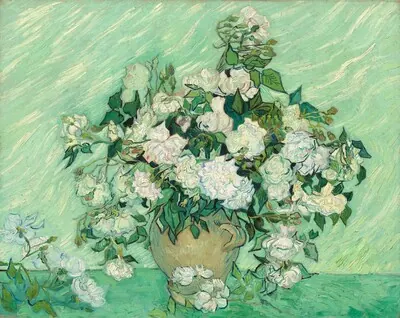
The painting’s story and details
These roses were pink. Their red pigment faded over time, leaving the bouquet almost white today. Van Gogh painted it in May 1890 before leaving the asylum at Saint-Rémy. Together with another bouquet of roses and two paintings of irises, it formed a series. He was comparing different formats and colour combinations. The picture’s present appearance preserves only part of that experiment.
The simple jug almost disappears beneath the flowers. Its handle is visible on the right, its neck concealed by leaves, and its rounded body painted in broad ochre strokes. The low container allows the bouquet to spread sideways. In this horizontal version, branches extend far beyond the compact vessel and occupy almost the entire space. The small support beneath them makes their abundance palpable.
At the centre, the roses consist of thick curls of paint. Whitish, blue and occasionally pinkish passages remain distinguishable, but the original colour relationships have changed. Research for the Metropolitan Museum’s 2015 exhibition connected the loss of pink to light-sensitive red lake pigments. The present whiteness therefore cannot confidently be interpreted as a symbol Van Gogh deliberately chose for these flowers.
A slender branch on the left curves almost to the edge. Dark contours separate leaves from the background, while the pale flower heads look loose and irregular. The painter varies his degree of precision. A stem’s curve is immediately legible; individual petals have to be assembled from strokes by the eye. The bouquet retains a natural unruliness within a clearly organized silhouette.
Flowers also lie beside the jug, extending the bouquet across the table and connecting its upper mass with the bottom edge. Paint is thick enough for its surface to cast tiny shadows in raking light. Van Gogh left the floral still lifes behind to dry after his departure. They reached him in Auvers only in June.
Long diagonal bands cover the green background, passing behind the flowers and giving the large bouquet breathing room. Originally pink met green here: complementary colours that strengthen one another. This version was conceived as softer in effect than its upright companion. Even a quiet combination emerged from Van Gogh’s careful comparison of neighbouring hues.
The exact hues of every petal can no longer be recovered. Museum reconstructions indicate the broad principle of the lost combination while acknowledging uncertainty about its details. This is a case in which the history of materials directly changes what we see. Our response to white roses is real, but it developed after the artist. We encounter both his composition and the result of decades of light acting on paint.
Featured in tours
After Impressionism. Four different answers
Seurat, Cézanne, Van Gogh and Gauguin changed painting for different reasons.
Still life. The value and structure of things
Food, flowers, vessels, books and instruments in an owner’s life and a painter’s work.
More paintings to compare
 Vincent van Gogh
The Bedroom. Second version
September 1889 Vincent van Gogh
Self-Portrait
1887 Vincent van Gogh
Madame Roulin Rocking the Cradle (La berceuse)
1889 Vincent van Gogh
Irises
1890 Vincent van Gogh
Self-Portrait with a Straw Hat (obverse: The Potato Peeler)
1887 Vincent van Gogh
Wheat Field with Cypresses
1889Period, style and subject
- Movement
- Post-Impressionism
- Genre
- Still life
- Medium
- oil on canvas
- Collection
- National Gallery of Art, Washington
- Dimensions
- Overall, 71 × 90 cm
- Accession number
- 1991.67.1
Sources
Reproduction of a public-domain artwork. Image licence