Boy in a Red Waistcoat
Paul Cezanne · 1888-1890
Explore the painting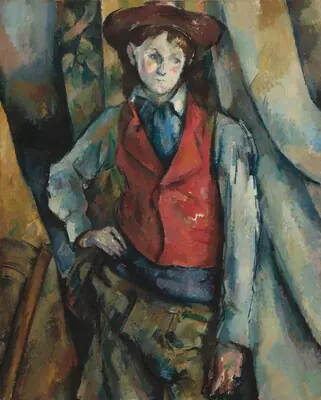
The painting’s story and details
In the late 1880s Cézanne hired a young model and painted him several times in a red waistcoat and leather trousers, the costume of an Italian peasant. Here the boy stands with a hand on his hip. The arrangement recalls sixteenth-century Italian aristocratic portraits. A familiar pose of high status belongs to someone whose job was to sit for an artist.
Beneath the dark hat is a small face turned aside. Green and mauve patches sit beside the warm ochre of the skin. Cézanne builds volume with separate areas of colour, leaving their edges visible. Against the broad shoulders and long arms, the head looks particularly young. That imbalance gives the formal pose an adolescent awkwardness.
The red waistcoat occupies the centre of the figure. Its colour shifts from orange in lighter areas to deep brown at the edges. The blue shirt surrounds the red and connects with blue passages in the curtain. The clothes retain recognisable folds and fastenings, but the large relationships of red and blue shape the painting before we examine those particulars.
The bent arm forms a triangle at the waist. In a formal portrait, such a gesture often gave the sitter an assured presence and emphasised his right to occupy space. The National Gallery compares this arrangement with Titian’s portrait of Ranuccio Farnese. It is a useful historical parallel, although direct copying of that particular painting is not documented.
The other arm hangs freely beside the body, its long contour picked out in dark blue. The bent elbow broadens the figure at the waist, while the lowered arm emphasises its length. This asymmetry unsettles the formal pose.
The curtain’s pattern consists of broad yellow, grey and blue bands. In places, the boundary between a fabric fold and a free patch of colour becomes difficult to locate. This patterned surface presses close to the figure, leaving almost no room behind him. A small fragment of chair at the lower left anchors a space otherwise filled by body and fabric.
The painting appeared in Cézanne’s exhibition at the Paris dealer Ambroise Vollard’s gallery in 1895. The collector Egisto Fabbri bought it the following year. Such exhibitions and purchases gradually widened the audience for an artist who had long worked without secure recognition. Abrupt contours, uneven proportions and exposed brushwork could become prized qualities for collectors, despite their distance from polished academic finish.
Featured in tours
After Impressionism. Four different answers
Seurat, Cézanne, Van Gogh and Gauguin changed painting for different reasons.
More paintings to compare


Period, style and subject
- Movement
- Post-Impressionism
- Genre
- Portrait
- Medium
- oil on canvas
- Collection
- National Gallery of Art, Washington
- Dimensions
- Overall, 89.5 × 72.4 cm
- Accession number
- 1995.47.5
Sources
Reproduction of a public-domain artwork. Image licence