Fête champêtre (Pastoral Gathering)
Jean Antoine Watteau, assisted by Jean-Baptiste Pater · 1718–21
Explore the painting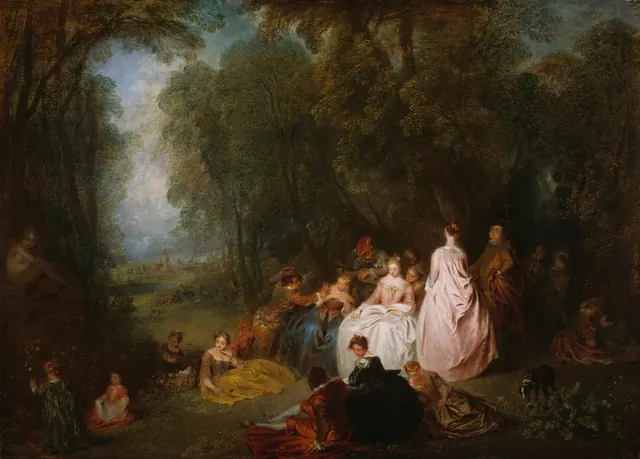
The painting’s story and details
Well-dressed people have gathered among trees to stroll and converse. Antoine Watteau specialized in scenes combining recognizable activities of fashionable society with settings reminiscent of theatre. The Pastoral Gathering dates to 1718–1721. The museum suggests that Watteau may have begun it and his pupil Jean-Baptiste Pater completed it.
A standing woman in pink turns her back towards us. Her pale figure is visible from a distance, but her face remains hidden. Her body’s direction connects her to the seated company. We approach a conversation already under way, staying outside its circle.
A seated woman’s light dress gathers illumination at the group’s centre. Tilted heads and faces turned towards one another appear nearby. Small changes of pose carry much of the action. Social exchanges receive the attention that historical painting devoted to ceremonial deeds.
In the foreground, a man sits with his back towards us. His warm-coloured clothing brings this part of the gathering closer, while farther figures recede into shade. Several small groups form, each with its own conversation. The eye can follow different routes through the painting.
Young people sit close together on the left. The museum reads courtship in the central groups. Gestures and the gathering’s character support this interpretation. It connects separate pairs through the subject of love while leaving their particular relationships uncertain.
Children appear at the left edge. The museum links them to the first of three stages, followed by courtship in the centre and a couple’s intimacy on the right. A walk can thus become a story of different ages. This reading explains the arrangement while the scene remains a gathering happening at one moment.
Heavy canopies occupy the upper canvas. Autumnal tones and late light support the museum’s interpretation of fleeting pleasure. Nature occupies most of the space, while the fashionable company fills a narrow lower band. Its activity seems a brief episode within a more extensive landscape.
On the right, a couple almost disappears into shadow. Viewers become outsiders observing a private approach. The pastoral setting offered an appealing, seemingly unrestricted setting for such relationships. Work, household management and daily schedules remain beyond this leisure scene.
The Academy recognized Watteau’s particular kind of painting as fêtes galantes. His works did not fit comfortably into existing genres. Pater’s possible participation also points to this new art continuing through studio practice and followers. The museum does not establish an exact division between the two artists’ hands here.
Featured in tours
Love, marriage and encounters
Gods, lovers, spouses and people whose relationships remain unknown.
More paintings to compare
Period, style and subject
- Movement
- Rococo
- Genre
- Everyday life
- Medium
- Oil on panel
- Collection
- Art Institute of Chicago
- Dimensions
- 48.6 × 64.5 cm
- Accession number
- 1954.295
Sources
Image provided under CC0. Image licence
Adapted and translated from Art Institute of Chicago materials. · Text licence