The Italian Comedians
Jean Antoine Watteau · probably 1720
Explore the painting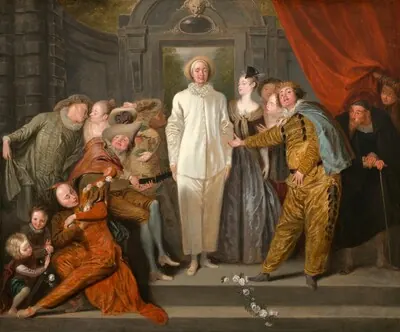
The painting’s story and details
Pierrot in white stands before us, surrounded by a tightly gathered company. The painting was probably made around 1720 for the London physician and collector Richard Mead. Watteau had arrived in England seriously ill. Theatre was a lasting interest of his. Here the group resembles performers taking a curtain call, although no particular production can be established.
Pierrot looks straight ahead, his arms hanging freely. Pale clothes separate him from the others, and a doorway frames his head and shoulders. In commedia dell’arte, recurring costume and manner made a character recognizable. Yet this Pierrot’s expression suggests no single feeling. We might see awkwardness, composure or anticipation, depending on how we read the surrounding gestures.
The actor in gold extends a hand towards Pierrot and turns his face out to the audience. He seems to present his companion. His bent posture and shimmering folds are especially animated beside the upright white figure. Scholars disagree about his character’s identity. The gesture’s function, however, is clear: it connects the central performer with those watching the stage.
On the left, Harlequin peers out behind the musician’s hat. His dark mask and diamond-patterned costume identify him. A face becomes an established theatrical sign, while the nearby people have differing expressions. Watteau combines theatrical convention with observation of behaviour. A role tells viewers what to expect; an individual glance or turn of the head adds something the costume cannot explain.
The seated musician holds a guitar across his knees. Flowers decorate its body, and his hand rests near the strings. Around him, figures turn in different directions, with small groups seemingly engaged in separate episodes. Our eye can move from instrument to flowers and from flowers to faces. Such connections are characteristic of Watteau, whose elegant gatherings consist of many individual encounters.
The red curtain is drawn to the right, revealing the performers and marking the boundary between stage and audience. In Paris, the ability to perform depended on political authority. The Italian company was expelled under Louis XIV in 1697, and a new troupe was invited in 1716 after his death. These theatrical costumes had a political history, although the group shown here cannot securely be assigned to a particular company.
The title became established through a 1733 engraving. Early accounts already described people portrayed in theatrical costumes. We may therefore be looking at an invented gathering rather than a record of a performance. Watteau preserves a moment when roles remain visible but action has almost stopped.
More paintings to compare
 Jean Antoine Watteau, assisted by Jean-Baptiste Pater
Fête champêtre (Pastoral Gathering)
1718–21 Jean Antoine Watteau
Mezzetin
ca. 1718–20 Jean Siméon Chardin
Soap Bubbles
probably 1733/1734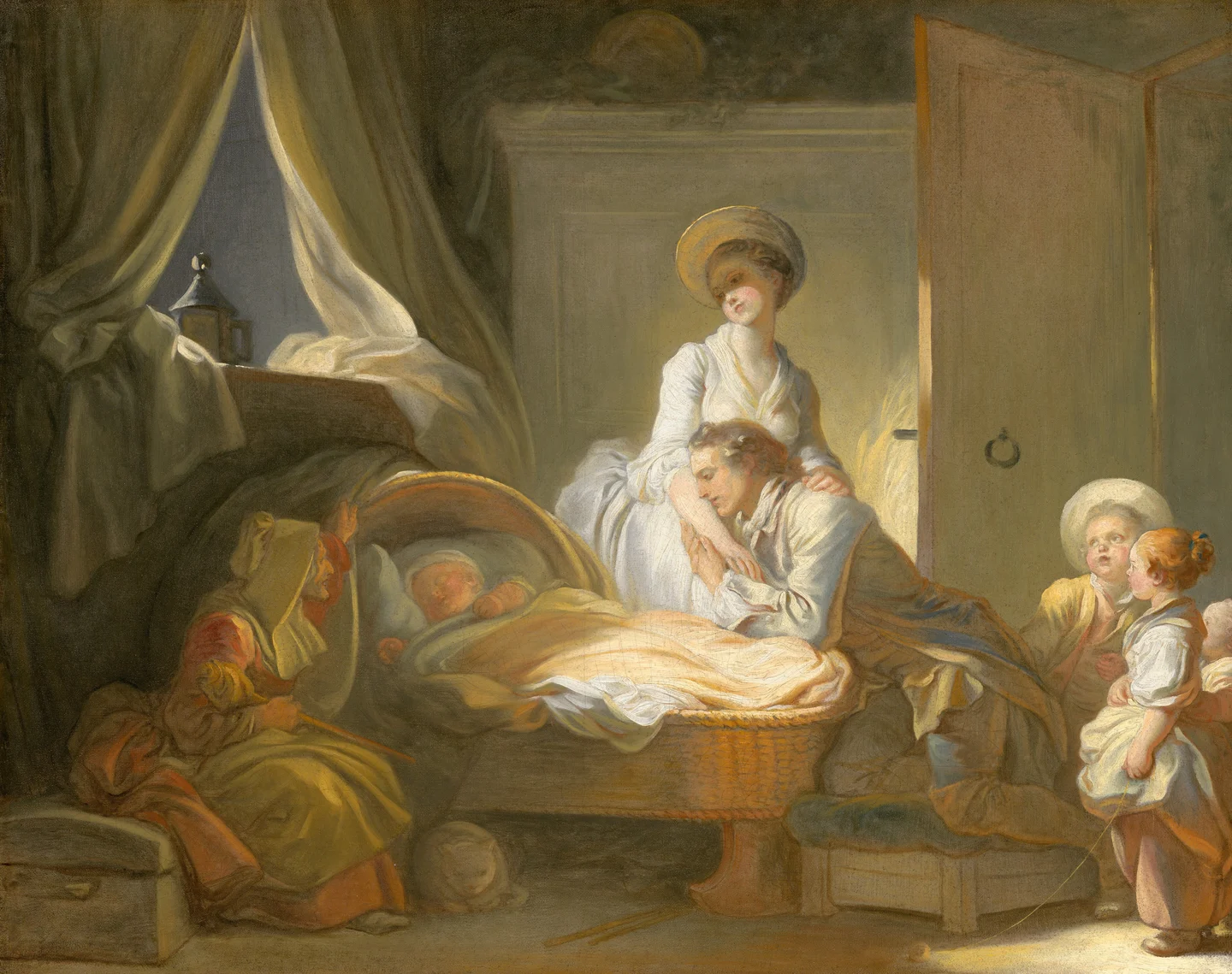 Jean Honoré Fragonard
The Visit to the Nursery
c. 1775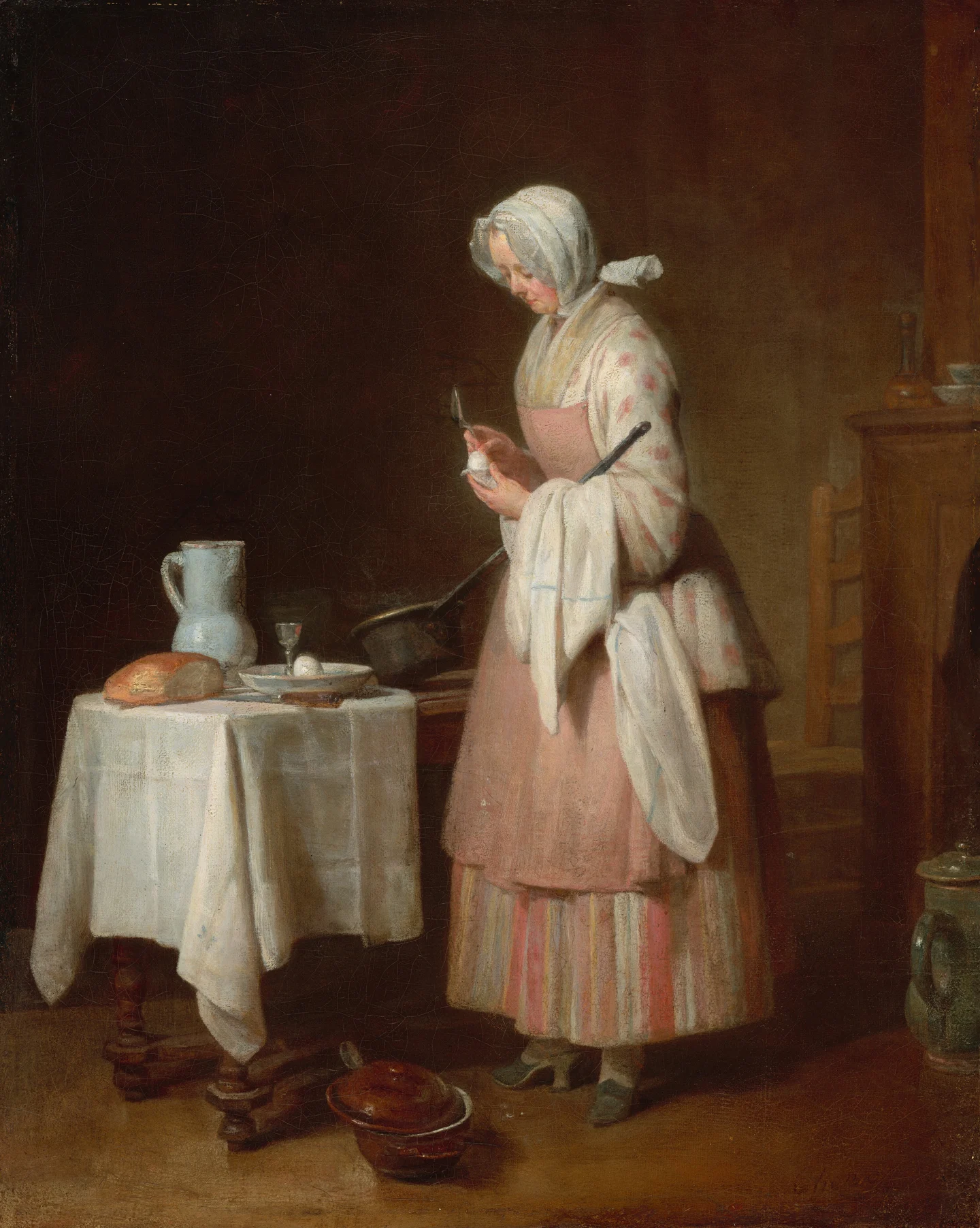 Jean Siméon Chardin
The Attentive Nurse
1747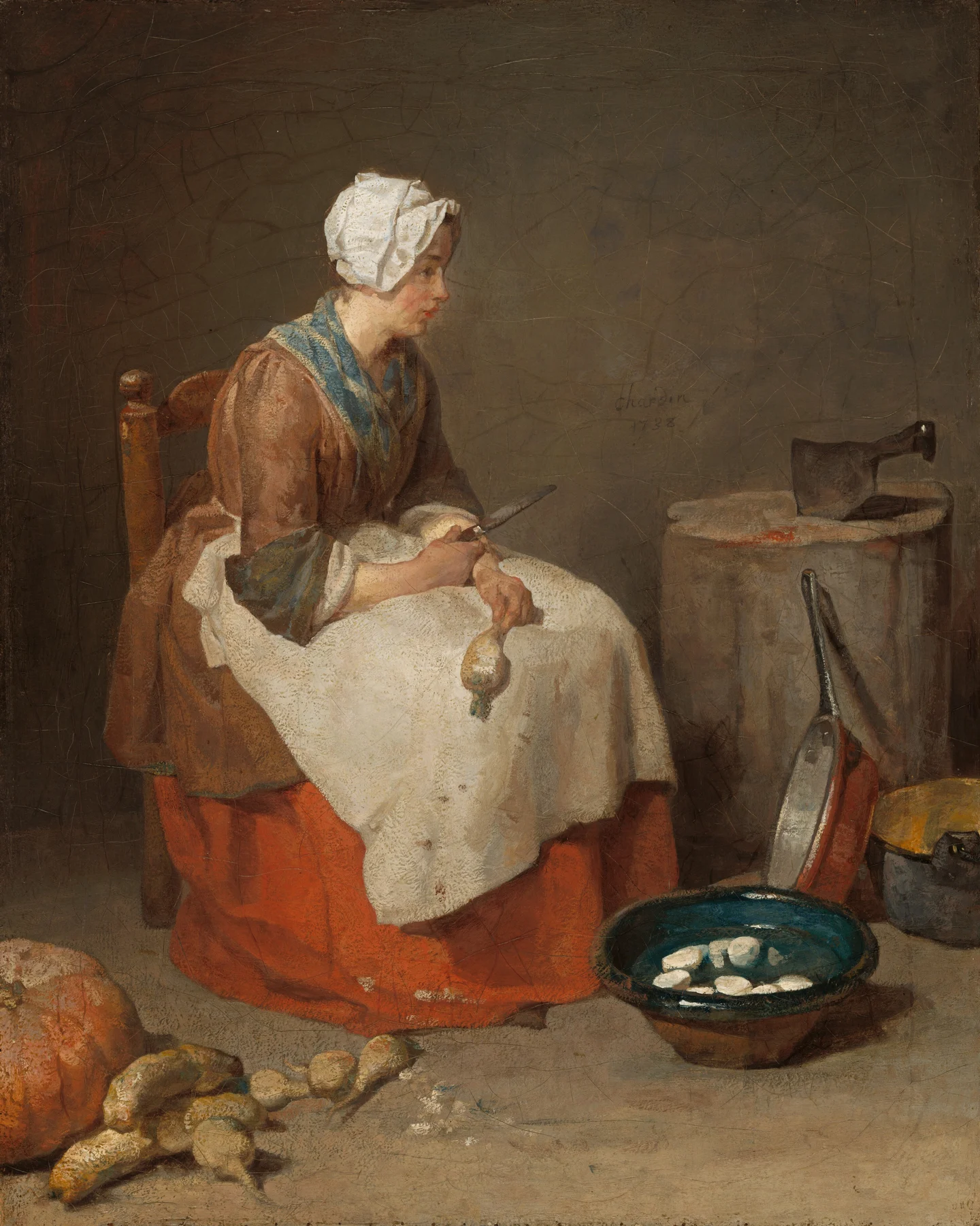 Jean Siméon Chardin
The Kitchen Maid
1738Period, style and subject
- Movement
- Rococo
- Genre
- Everyday life
- Medium
- oil on canvas
- Collection
- National Gallery of Art, Washington
- Dimensions
- Overall, 63.8 × 76.2 cm
- Accession number
- 1946.7.9
Sources
Reproduction of a public-domain artwork. Image licence