The Visit to the Nursery
Jean Honoré Fragonard · c. 1775
Explore the painting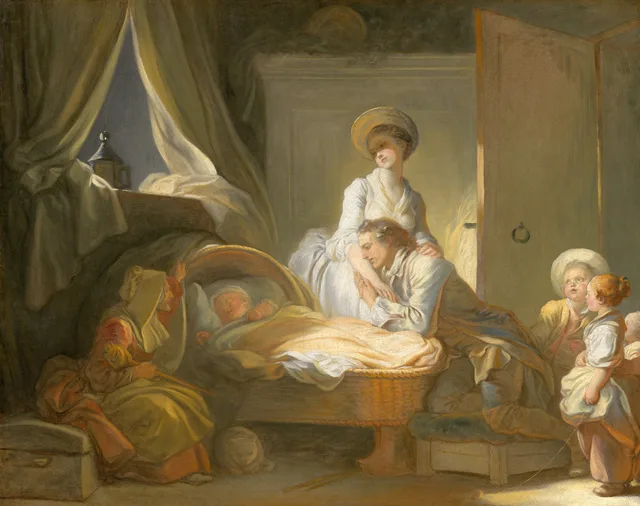
A young couple bend toward a sleeping infant while an older woman sits beside the cradle. Fragonard painted the scene around 1775. It is traditionally understood as a visit to a child in a nurse’s care. Prosperous eighteenth-century parents often entrusted early care to another household. Visiting affection meets the daily work of the person who remains after the guests depart.
The infant lies beneath the small canopy of a wicker cradle. The face occupies little space, yet the principal gestures converge on it. Light picks out white bedding and clarifies the room’s center. Adults act around an almost motionless focus, with the child providing the reason for shared attention.
The man kneels and leans against the standing woman’s arm as she touches his shoulder. Their gestures connect the couple’s closeness with attention to the child. Fragonard, famous for courtship and recreation, uses his ability to join figures through flexible lines in a domestic account of affection.
The older woman sits lower than the others with spinning equipment. She is established beside the cradle, while the younger couple seem to have arrived temporarily. Their poses distinguish visiting from continual presence. Her work enters through objects and position, quietly supporting the entire episode of parental affection.
Three children gather on the right, watching from different heights, with a ball of yarn rolling nearby. Fragonard introduces a small household incident into the tender encounter. The room becomes a place of continuing life, with activities and interests that preceded the visitors and will outlast their departure.
The window and parted curtains provide bright illumination. Broad handling of fabrics and dark corners suggests a rapidly caught moment, although the composition is carefully organized. Light favors the couple and cradle while the older woman remains darker. Illumination also assigns narrative prominence.
The painting can hold genuine affection alongside an unequal distribution of care. Parents receive the strongest light; the nurse has the permanent place beside the cradle. Fragonard presents this as part of household life rather than an accusation. The angle broadens an account of love by making its everyday supporting labor visible.
Featured in tours
Domestic life. Leisure and care
Sixteen paintings about reading, music, children and the work that makes domestic comfort possible.
More works by Jean Honoré Fragonard
- Medium
- oil on canvas
- Collection
- National Gallery of Art, Washington
- Dimensions
- 73 × 92.1 cm
- Accession number
- 1946.7.7
Sources
Museum reproduction. Public domain, NGA Open Access. Image licence