Amédée-David, the Comte de Pastoret
Jean Auguste Dominique Ingres · 1823–26
Explore the painting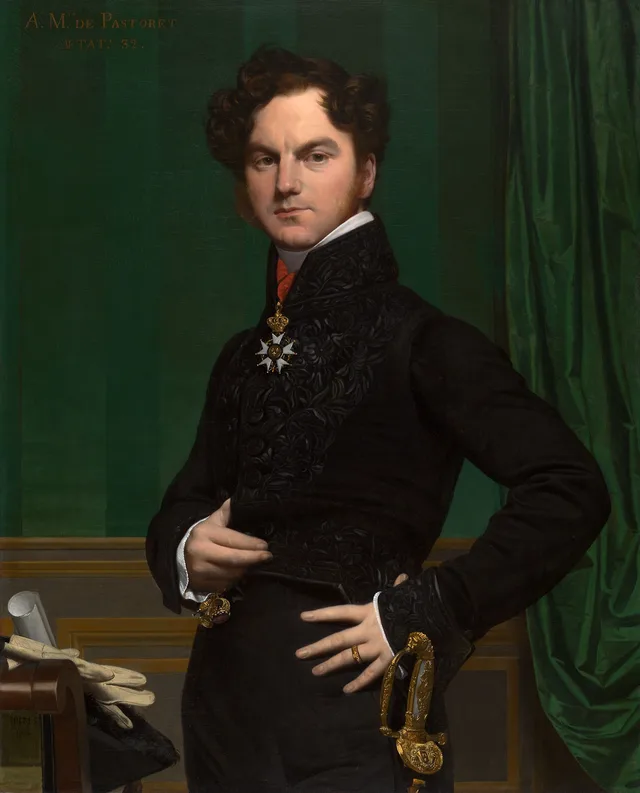
An inscription identifies the Comte de Pastoret as thirty-two years old. Ingres worked on his portrait between 1823 and 1826. The sitter was a friend and patron who commissioned other works and probably helped secure his election to the Académie des Beaux-Arts. Personal connections, artistic reputation, and social position supported one another in this relationship.
The head turns slightly, while the eyes look directly at us. Dark hair frames the illuminated forehead, and the outline of the face is carefully defined. Ingres sustains the encounter between sitter and viewer. No activity distracts Pastoret from posing; attention rests on how he presents himself through this composed, stationary stance.
The white star of the Legion of Honor hangs from a red ribbon. Small as it is, the decoration stands out against the black fabric and signals official recognition. Viewers familiar with such insignia could read the sitter’s position through the medal, his uniform, and his bearing without a lengthy account of his career.
Black embroidery nearly merges with the black uniform. Looking closely reveals leaves and scrolls across the collar and chest. Pastoret wears the uniform of an auditor of the Council of State. Slight differences in sheen disclose the elaborate decoration, bringing together the work of tailoring, embroidery, and painting within an apparently restrained silhouette.
One hand rests on his hip, while the other thumb slips inside his coat. An elbow extends broadly outward, allowing the pose to command space. The golden sword hilt adds another bright accent. Here the sword belongs to ceremonial dress and contributes to the portrait’s presentation of public service and rank.
Gloves and a hat lie on the chair at left, with a rolled sheet behind them. They suggest an arrival or departure and introduce contrasting textures beside the uniform. Green walls and drapery hold the setting together. Even the casually placed accessories contribute to this carefully arranged public image.
Edgar Degas purchased the portrait in 1897. He collected Ingres’s work and drew inspiration from his draftsmanship. The likeness of an influential patron thus became a resource for a later artist. Its renewed value lay in the figure’s construction, precision of contour, and the way a few gestures organize a substantial formal portrait.
More works by Jean Auguste Dominique Ingres
- Medium
- Oil on canvas
- Collection
- Art Institute of Chicago
- Accession number
- 1971.452
Sources
Wikimedia Commons reproduction. Public domain. Image licence