The Boating Party
Mary Cassatt · 1893/1894
Explore the painting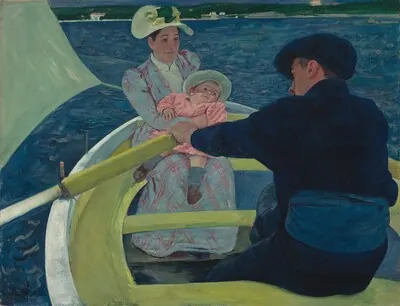
The painting’s story and details
A woman with a child sits opposite the rower. The boat is cropped so closely that the viewer almost enters it. Cassatt painted The Boating Party in 1893–1894, during her work on the Mediterranean coast. Her familiar adult-and-child group entered a new composition dominated by a huge dark foreground figure and vivid bands of yellow and blue.
The child leans back in the woman’s arms and turns towards the man. She supports the child across the body, preventing a slip. Their relationship emerges through an action needed in a moving boat. The baby stretches its legs freely while the woman sits upright and supports its weight. The difference between their postures shows care as continuous physical work.
The rower’s back occupies almost the entire right half. His dark clothes form broad areas, and only a profile of his face is visible. His size brings him close and obstructs a conventional view of the passengers. His hand reaches towards the oar while his torso inclines forwards. At the other end of the boat, soft pink and blue fabrics differ sharply from his dense dark silhouette.
The yellow-green side curves around the passengers, while the oar crosses the boat diagonally. The thwarts divide its interior into separate shapes. These lines both explain the object’s construction and organize the flat canvas. For a moment we can stop recognizing a boat and see how arcs and diagonals hold large colour areas in balance.
The sail enters on the left as a broad pale wedge. Its mast and upper edge remain beyond the frame. This cropped view prevents us from surveying the whole boat and strengthens our sense of being inside the scene. Cassatt closely studied Japanese prints. Their bold viewpoints and cropped forms offered European artists alternatives to organizing space through central perspective.
The shore and its tiny houses are pressed against the upper edge. Blue water fills almost everything between it and the boat. In a conventionally deep landscape, our eye could travel easily into the distance. Here the high horizon returns it to the passengers. Space exists but is deliberately compressed. The museum connects this approach with the decorative experiments of Post-Impressionism.
In 1895 the painting became the centrepiece of Cassatt’s first solo exhibition in the United States. American audiences encountered an artist whose career had developed in France. She is often remembered for mothers and children, yet this work shows how many bold pictorial decisions a familiar subject could accommodate. Returning to a theme allowed her to change how people and their surroundings were represented.
Featured in tours
Women painters. Learning and working
Family workshops, academies, private commissions and independent exhibitions.
More paintings to compare

Period, style and subject
- Movement
- Impressionism
- Genre
- Everyday life
- Medium
- oil on canvas
- Collection
- National Gallery of Art, Washington
- Dimensions
- Overall, 90 × 117.3 cm
- Accession number
- 1963.10.94
Sources
Reproduction of a public-domain artwork. Image licence