Children Playing on the Beach
Mary Cassatt · 1884
Explore the painting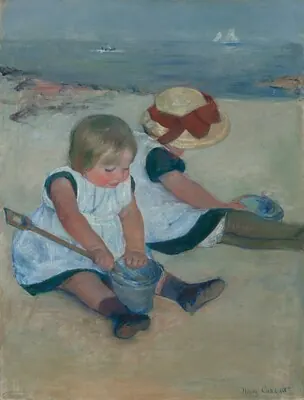
The painting’s story and details
Two girls sit back to back on the sand. Each has a pail, and both are absorbed in play. Cassatt painted the picture in 1884, soon after travelling to Spain with her ailing mother. The museum associates it with her return from that journey. Seaside subjects were unusual in her work. Here the coast becomes a setting for her sustained attention to children.
The nearer girl looks into her pail. Her plump hands grip the toys, and her legs spread to accommodate the container between them. Her whole posture serves a simple task. Cassatt describes the bowed head and gripping fingers clearly enough for us to understand the child’s activity. Against the open sea, this small patch of sand becomes the place that matters most to her.
The second girl turns away from us. Her hat conceals her face, but the arm reaching towards her pail is clearly visible. Similar dresses and physical closeness suggest a family relationship, although the models’ names are unknown. They play beside one another, almost touching, while remaining separately occupied. It is a familiar way of being together that does not require constant conversation or exchanged glances.
The red ribbon on the straw hat stands out among blues and pale tones. Its large bow makes the head’s turn legible even without a visible face. Colour helps us understand the figure’s position. Below, a dark sleeve separates the arm from the white pinafore, while the broad brim echoes the round pail. A few recurring shapes connect the child’s activity with her silhouette.
A long wooden shovel crosses the lap diagonally. Cassatt brings it close to the edge, making the toy feel within reach. X-rays revealed numerous changes throughout the painting. A scene resembling a passing observation was developed in the studio. She sought an arrangement of hands, toys and legs that would make the activity immediately readable while preserving its liveliness.
Distant sails are indicated with a few touches of white. Compared with the children, the sea is thinly and broadly painted. Boats remain recognizable but soon return our attention to the large figures. The children occupy almost the canvas’s full height, while the sails remain tiny marks near the horizon. Different blues connect dresses, pails and water within a single luminous space.
Cassatt’s sister Lydia had died two years before the painting. The museum suggests that the two girls’ closeness might evoke the bond between sisters. This is a possible reading rather than an established subject. In 1886 the work appeared at the final Impressionist exhibition. Children’s play took its place among experiments in new painting, making everyday family life a subject of serious artistic attention.
Featured in tours
For children. Everyday life before us
Homes, school, trains and games in twelve paintings. For ages 8–12 and adults.
Women painters. Learning and working
Family workshops, academies, private commissions and independent exhibitions.
More paintings to compare

Period, style and subject
- Movement
- Impressionism
- Genre
- Everyday life
- Medium
- oil on canvas
- Collection
- National Gallery of Art, Washington
- Dimensions
- Overall, 97.4 × 74.2 cm
- Accession number
- 1970.17.19
Sources
Reproduction of a public-domain artwork. Image licence