On a Balcony
Mary Cassatt · 1878–79
Explore the painting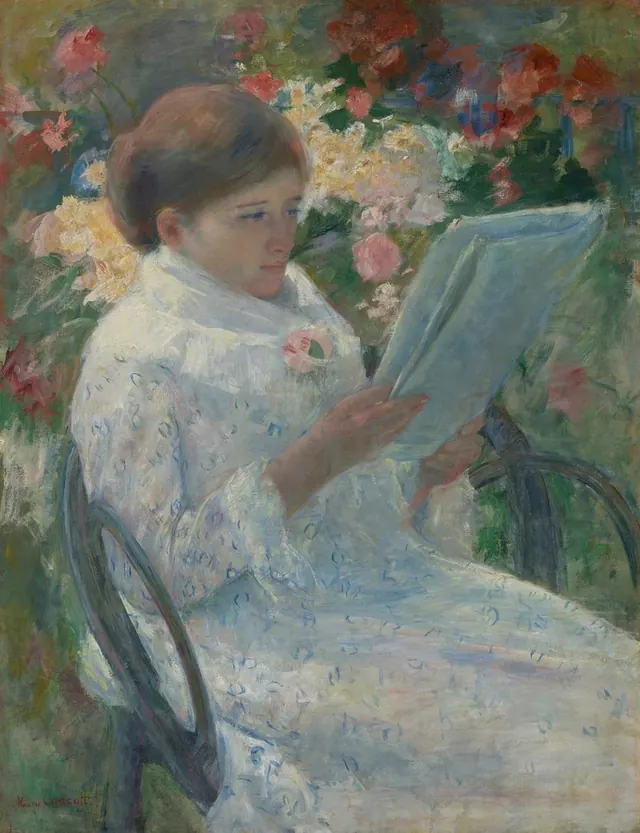
The painting’s story and details
A woman has settled among the flowers with a newspaper. Her morning dress, comfortable chair and enclosed garden offer privacy. Yet her reading connects this quiet corner with events beyond it. Mary Cassatt painted On a Balcony in 1878–79, as she was joining the Impressionists. Their interest in contemporary life extended to these hours when someone has time to herself.
The reader lowers her eyes towards the page. We see her face from the side, and she does not seek our gaze. Cassatt often painted women engaged in familiar activities, attending to their posture and concentration. This figure fills almost the entire canvas. Everyday reading receives the space and attention that might otherwise be given to a formal portrait.
The newspaper is held close to her face. We cannot make out its title or articles, so there is no basis for assigning the reader particular political opinions. The Art Institute of Chicago connects her choice of a newspaper with the modern character of the subject. Politics, discoveries and city news might be discussed beyond the railing; reading allows her to take part in that wider conversation from home. A private morning can also involve an interest in public affairs.
One hand holds the newspaper near its middle, while the other supports it from below. Cassatt carefully arranges this ordinary movement. The slant of the page follows the direction of the reader’s gaze, and her fingers draw our eye towards its edge. Face, hands and page form a close relationship. Her hands show how she holds the large sheet, revealing the small physical effort involved even in this quiet activity.
Blue, pinkish and yellowish strokes appear across the white dress. At close range they separate into marks of the brush; from a distance they gather into lit fabric, folds and pattern. The painting itself demonstrates an Impressionist approach to handling paint. Cassatt preserves recognisable forms while allowing us to see how they are made. The softness of the fabric and the light around the figure emerge from neighbouring touches of colour.
Red and pink flowers surround the head, with patches of white and yellow among them. Their petals are more loosely defined than the face and hands. This difference keeps our attention on the reader despite the busy planting around her. In 1877 Degas invited Cassatt to exhibit with the independent artists. Working alongside them changed her colour and composition, while the human figure remained central to her practice.
The curved parts of the chair enclose the figure, and the railing behind the flowers separates the garden from the space beyond. For a well-to-do woman in nineteenth-century Paris, social conventions affected where she could freely spend time and work. Cassatt painted the settings she knew — homes, gardens and theatre boxes. These offered both restrictions and opportunities. Such a well-kept garden allows leisure for reading; the experience of working women with fewer resources is outside this scene.
Cassatt showed On a Balcony at the fifth Impressionist exhibition in 1880. Independent exhibitions allowed artists to reach the public without selection by the official Salon jury. An activity normally hidden from strangers became the subject of a public display. The painting was later exhibited in the United States and entered the Art Institute of Chicago in 1938. It now suggests how differently people could participate in city life, including through a newspaper read in their own garden.
Featured in tours
Early Impressionism. Paris 1860–1879
The Salon, the first independent exhibition, railway stations, studios and leisure on the Seine.
Women painters. Learning and working
Family workshops, academies, private commissions and independent exhibitions.
More paintings to compare

Period, style and subject
- Movement
- Impressionism
- Genre
- Everyday life
- Medium
- Oil on canvas
- Collection
- Art Institute of Chicago
- Dimensions
- 85.2 × 65.5 cm
- Accession number
- 1938.18
Sources
Image provided under CC0. Image licence
Adapted and translated from Art Institute of Chicago materials. · Text licence