The Races at Longchamp
Édouard Manet · 1866
Explore the painting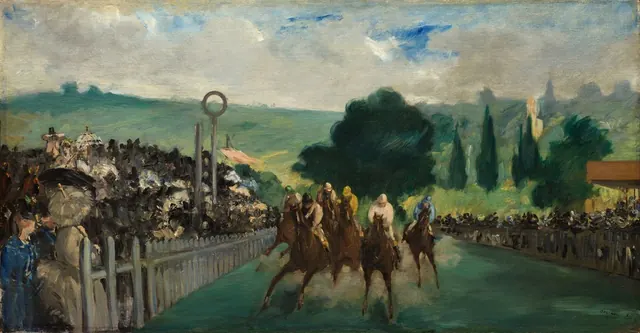
The painting’s story and details
The horses race almost directly towards us. Manet painted the finish at Longchamp in 1866, choosing an unusual position ahead of the approaching group. The racecourse stood beside the Bois de Boulogne on Paris’s western edge. Sport, fashionable society and popular entertainment met there. Proximity conveys the spectacle in a way a safe sideways overview could not.
A jockey in white stands out near the centre. Dark masses describe his horse, whose legs barely resolve into clear forms. Manet reduces detail to sustain movement. The riders seem glimpsed during a brief interval before the eye has distinguished every competitor.
Horses bunch together on the left. Overlapping heads and bodies complicate the identification of a winner. The picture retains competitive tension without becoming a race report. Our attention centres on the approaching group and the need to grasp the event quickly.
The near fence directs attention towards the riders. Its lines converge in depth and spread sharply beside us. Sporting pictures often showed horses in profile so that their conformation could be assessed. Manet’s frontal view makes speed and distance the immediate concern.
Fashionably dressed women and men crowd behind the barrier. The racecourse was also a place to appear in society. Pale dresses, parasols and dark male clothing form another spectacle. Patrons watched the race while presenting themselves to other visitors.
High on the left, a man uses binoculars. The instrument supplies details Manet’s free brush leaves unclear. Different ways of watching coexist: distant optical observation, a place at the fence and an imagined position in front of the horses.
Trees and a distant crowd frame the jockeys’ coloured jackets. Horse racing, imported from England, became part of nineteenth-century urban culture. Nature here belongs to a deliberately arranged entertainment venue with tracks, fences and designated viewing positions.
Manet originally planned a larger composition and later cut down the canvas himself. Today’s forceful approach therefore also depends on a subsequent choice of boundaries. Viewpoint, selective detail and the canvas’s tight boundaries make the horses seem to race towards us just before the finish.
Featured in tours
Early Impressionism. Paris 1860–1879
The Salon, the first independent exhibition, railway stations, studios and leisure on the Seine.
More paintings to compare


Period, style and subject
- Movement
- Realism
- Genre
- Everyday life
- Medium
- Oil on canvas
- Collection
- Art Institute of Chicago
- Dimensions
- 44 × 84.2 cm
- Accession number
- 1922.424
Sources
Image provided under CC0. Image licence
Adapted and translated from Art Institute of Chicago materials. · Text licence