The Railway
Édouard Manet · 1873
Explore the painting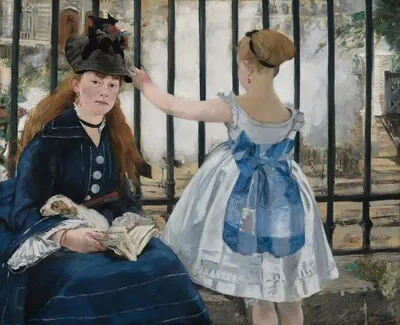
The painting’s story and details
In 1873 Manet painted a scene beside the tracks of the Gare Saint-Lazare. This part of Paris was changing rapidly with the railway, bridges and new buildings. The artist lived and worked nearby. The industrial city enters everyday life through steam, an iron fence and activity beyond it. The train itself is hidden, while a woman and a girl occupy almost the entire foreground.
The woman was modelled by Victorine Meurent, familiar from Olympia and Luncheon on the Grass. Here she wears city clothes: a dark dress with white trim and a tall flowered hat. She looks straight at us. Her book remains open, as though reading has been interrupted. The painting leaves both the cause of the interruption and her relationship to the child unspecified.
The girl turns her back and holds a fence bar. A large blue bow spreads across her white dress. The costumes seem to exchange colours: white trim on blue at the left, blue on white at the right. Their attention travels in different directions. The woman looks towards us; the child watches what is happening below, beyond the railings.
Black bars divide the space into narrow strips. Beyond them steam conceals the tracks and part of the buildings. The fence is close, the distant city visible only in fragments. The museum suggests a social reading of this boundary between fashionably dressed people at leisure and an industrial zone. That is an interpretation; the railings directly determine what each of us can see.
A small dog sleeps in the woman’s lap beside an open book and a red fan. These objects form a quiet area among the iron verticals. The dog curls up, hands hold the pages, and trains move beyond the fence. Manet brings different activities and rhythms of city life into one scene without making them part of a single action.
Steam rises between the heads and conceals much of the background. Buildings remain visible at the sides, with part of the Pont de l’Europe on the right. The white mass signals a working machine that we cannot see. The locomotive’s absence makes the title unexpected: the railway is present through the changes it has brought to the surrounding space.
Manet showed the painting at the official Salon of 1874. That same year his friends held the first independent exhibition of the future Impressionists. He shared their interest in modern life while continuing to seek recognition at the Salon. The Railway brought the experience of new Paris into that institution: incidental human proximity, an obstructed view and an event more visible to one figure than another.
Featured in tours
Early Impressionism. Paris 1860–1879
The Salon, the first independent exhibition, railway stations, studios and leisure on the Seine.
More paintings to compare


Period, style and subject
- Movement
- Realism
- Genre
- Everyday life
- Medium
- oil on canvas
- Collection
- National Gallery of Art, Washington
- Dimensions
- Overall, 93.3 × 111.5 cm
- Accession number
- 1956.10.1
Sources
Reproduction of a public-domain artwork. Image licence