The Spanish Singer
Édouard Manet · 1860
Explore the painting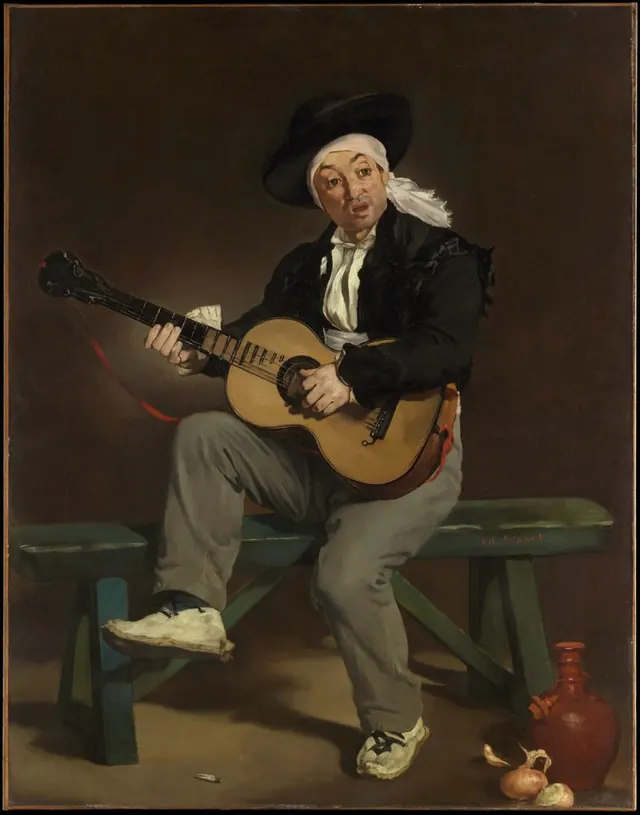
The painting’s story and details
This painting brought Manet his first success at the Salon of 1861. Viewers saw a Spanish singer, although he had assembled the scene from a model and costumes in his Paris studio. He would travel to Spain only in 1865. The picture shows how enthusiasm for another culture could help establish a new pictorial language.
The singer holds the guitar left-handed, but it is strung for a right-handed player. His fingering also suggests unfamiliarity with the instrument, a discrepancy noted by the museum. Manet gives priority to the open mouth, turned head, and widely placed legs: a clear, recognizable performer’s pose.
The brown background contains no window, decorated wall, or audience. The figure stands forward and is readable almost in full. This approach connects Manet with Velázquez, whose painting he admired. The Spanish character comes through both the costume and the way a person occupies an otherwise empty space.
The white shirt and headscarf stand sharply against the black jacket. Manet leaves broad brush movements visible. Light takes the form of substantial pale areas, while shadow does not dissolve into endless smooth gradations. A restrained palette gives the figure volume without concealing the energy of its execution.
A jug and onions sit by his feet. With the simple footwear, they give the theatrical costume a suggestion of ordinary life. This is a small still life within the portrait. Reddish clay echoes the guitar strap, while the pale flesh of a cut onion answers the white shirt. The objects establish a setting and connect the colors.
Gray trousers occupy much of the canvas. Long strokes describe their folds, sometimes almost in a single movement. The assurance of this painting helped win contemporary approval. Delacroix, Ingres, and Baudelaire took notice. The familiar Spanish subject made a manner acceptable that would soon provoke much sharper disputes.
Manet received an honorable mention for The Spanish Singer and continued seeking recognition at the official Salon. Only two years later, his Luncheon on the Grass was rejected and caused a scandal at the Salon des Refusés. Initial approval was followed by confrontation with the limits of the same public’s tolerance.
Featured in tours
Early Impressionism. Paris 1860–1879
The Salon, the first independent exhibition, railway stations, studios and leisure on the Seine.
More paintings to compare


Period, style and subject
- Movement
- Realism
- Genre
- Everyday life
- Medium
- Oil on canvas
- Collection
- The Metropolitan Museum of Art
- Dimensions
- 147.3 × 114.3 cm
- Accession number
- 49.58.2
Sources
Image provided under CC0. Image licence