The Old Musician
Édouard Manet · 1862
Explore the painting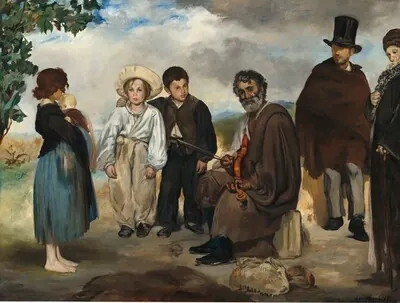
The painting’s story and details
Manet painted this large work in 1862, when the rebuilding of Paris was displacing poor residents from older neighbourhoods. People for whom the new city left little room gathered on undeveloped outskirts. The painter gave them a scale familiar from ceremonial painting. The group occupies almost the whole foreground, and its central figure calmly meets our gaze.
The violinist was modelled by Jean Lagrène, a street musician who also earned money posing for artists. The violin rests before him, the bow held to one side. The moment allows for a pause before or after playing. More significantly, his carefully painted face holds our attention. A man who usually performed for passers-by has received a substantial portrait of his own.
One boy rests a hand on the other’s shoulder. Their dark and light clothes differ sharply, but the gesture joins the figures. The younger boy’s white outfit, broad hat and lowered hands recall Watteau’s Pierrot, a connection noted by scholars. Manet assembles people of his own time while bringing memories of earlier French painting into the scene.
At the left a girl holds an infant. Her bare feet rest on the earth, and broad blue bands describe her long skirt. The turn of her head largely conceals her face. The infant peers over her shoulder, adding another age to the group.
The man in the top hat stands slightly behind, wrapped in a brown cloak. At the right edge another elderly man leans on a cane, his figure partly cut off by the frame. Their gazes do not meet at one point. Despite their physical proximity, the group retains the separateness of people who might gather in a street. Any kinship or shared history remains unknown.
A worn bag with a strap lies before the violinist. The dark ground is almost empty, and an indistinct landscape opens behind the people. There is no address from which to reconstruct a particular meeting place. The figures stand close to us, arranged along a shallow stage-like space. Manet composed this scene from individual figures, joined by their position on the margins of urban life.
The connection with Watteau continued through Picasso. In its study of Family of Saltimbanques, the museum compares the small acrobat with Manet’s boy and considers a deliberate reference possible. The image of a child from the margins of Paris thus entered painting’s history alongside theatrical figures. The model’s social obscurity gave way to a long artistic life for his image.
Featured in tours
Early Impressionism. Paris 1860–1879
The Salon, the first independent exhibition, railway stations, studios and leisure on the Seine.
More paintings to compare


Period, style and subject
- Movement
- Realism
- Genre
- Everyday life
- Medium
- oil on canvas
- Collection
- National Gallery of Art, Washington
- Dimensions
- Overall, 187.4 × 248.2 cm
- Accession number
- 1963.10.162
Sources
Reproduction of a public-domain artwork. Image licence