Beggar with Oysters (Philosopher)
Édouard Manet · 1865–67
Explore the painting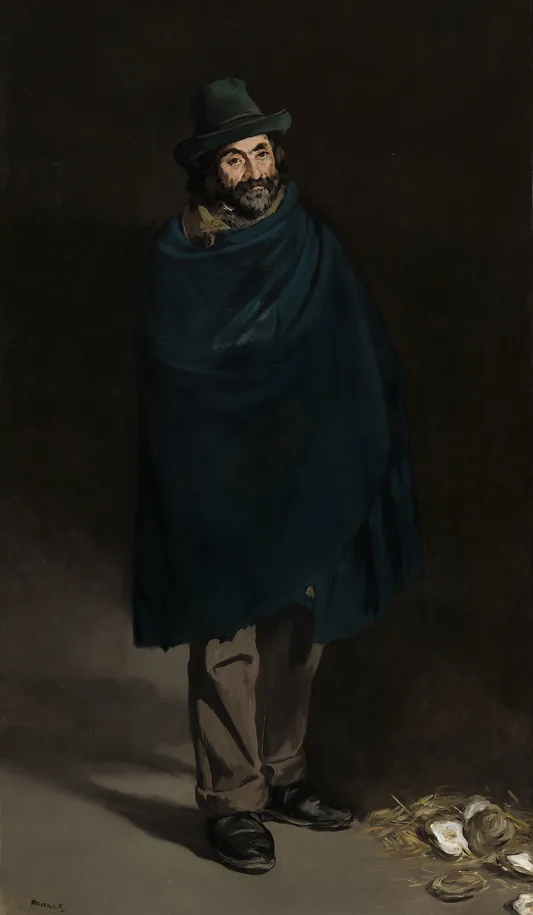
Manet painted this full-length figure in a blue cloak in 1865–1867 as part of four works called The Philosophers. The title recalls representations of ancient Stoics, whose poverty could signify independence from wealth. Contemporary viewers would also recognize a type familiar from Parisian streets. An older artistic tradition reframed a modern poor man’s presence.
A bearded face appears beneath the broad brim. The head tilts slightly, with the eyes turned towards the viewer. Separate strokes establish light and dark areas. Up close, the loose application of paint is especially clear. From a distance, these touches resolve into the features of a person singled out from an anonymous city crowd.
The cloak conceals the hands and much of the body. Its blue-green colour stands against the brown background, while broad folds unite the figure into a single silhouette. The wrapped man is almost motionless. Manet builds the image around his stance before the viewer. Concealed hands remove gestures that might associate him with a particular activity.
Creased trousers emerge beneath the cloak, gathering in heavy folds near the shoes. Manet uses larger, more angular passages of paint here than in the face. The difference guides our attention down the figure, conveying fabric and bodily weight without cataloguing every mark of wear.
Open oyster shells and straw lie at lower right. Their pale interiors contrast with the surrounding earth colors. This small group supplies the painting’s distinguishing title, yet does not explain what happened before the sitting. It adds a tangible trace of food and everyday city life beside an almost monumental figure.
A shadow extends leftward from the shoes, while the junction between wall and floor remains vague. There are no streets or passersby to distract us or invite comparisons. The large format reinforces this isolation: one person receives the space conventionally granted to distinguished figures in formal portraits or history painting.
The dealer Paul Durand-Ruel acquired the painting in 1872; in 1894 it passed to the Chicago collector Arthur Jerome Eddy. An image of a poor man became a collector’s possession. Its later history adds another question to Manet’s project: how does our attention to a person change when his image gains recognition and a price on the art market?
More works by Édouard Manet


- Medium
- Oil on canvas
- Collection
- Art Institute of Chicago
- Accession number
- 1931.504
Sources
Wikimedia Commons reproduction. Public domain. Image licence