Beggar with a Duffle Coat (Philosopher)
Édouard Manet · 1865–67
Explore the painting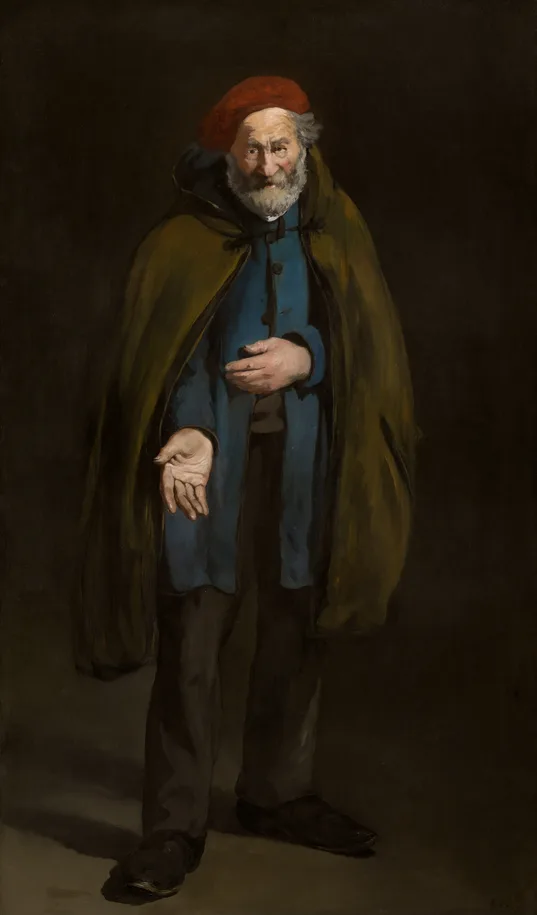
Manet painted this man in the mid-1860s, as Paris was undergoing rapid redevelopment. New boulevards and expensive neighbourhoods were transforming the city and pushing poorer inhabitants towards its edges. In 1872 he exhibited this painting with three related works under the collective title The Philosophers. Poverty thus connects with an older tradition of depicting a sage who lives without wealth. Yet this is also a contemporary Parisian whom a prosperous exhibition visitor might have encountered in the street.
A red beret frames the grey-haired face. Light picks out wrinkles, a cheek and the white beard, without becoming an exhaustive inventory of age. Broad strokes suffice to make the man vivid and individual. He looks towards us with his head slightly inclined. Such direct contact was familiar from portraits of people with names and established social positions. Here the museum leaves the sitter unidentified, while the painter grants him a large canvas and a presence of his own.
An open palm extends towards the viewer. The gesture identifies a petitioner before we read the title. It both addresses us and exposes someone who has nothing to offer in exchange. Manet illuminates the hand almost as insistently as the face. This makes detached viewing difficult. We occupy the position of the person being approached, even though the distance of a museum frees us from having to respond to the request.
The other hand rests near the chest against blue clothing. Together the hands create a quiet, slightly awkward movement, far removed from heroic gesture. The brown-green cloak falls in large folds and broadens the silhouette. Its fabric is handled freely, without carefully finishing every seam. Manet relies on clear relationships between large areas of colour. At a distance they form a unified figure; close up, they retain the movement of the brush and the material presence of paint.
Heavy dark shoes stand directly on the ground. A small shadow anchors the figure in space. There is no picturesque street or entertaining anecdote of poverty to distract us. The full-length format gives ordinary clothing the visibility that formal portraiture usually reserved for a uniform or court dress. Social difference remains, but the customary allocation of attention between rich and poor has been disturbed.
The nearly empty dark background removes any address or domestic circumstances. It helps connect this contemporary man with philosophers in earlier painting. Yet the device also has a limit. Without an individual history, a poor person can become a reassuring image of the freely independent sage. The urban context therefore matters. His situation belongs to a changing Paris and its inequalities, even if the picture invites us to imagine a voluntary renunciation of comfort.
Manet came from a prosperous family, but experienced rejection from the artistic establishment. The museum suggests that he may have identified with his excluded subjects. This is a possible explanation of his choice, rather than an established biography of the sitter. The painting leaves us a harder question. Does a monumental image of a poor man help us recognise an equal, or turn his deprivation into something beautiful to contemplate? The extended palm prevents the second possibility from disappearing.
More works by Édouard Manet


- Medium
- Oil on canvas
- Collection
- Art Institute of Chicago
- Accession number
- 1910.304
Sources
Wikimedia Commons reproduction. Public domain. Image licence