The Biglin Brothers Turning the Stake
Thomas Eakins · 1873
Explore the painting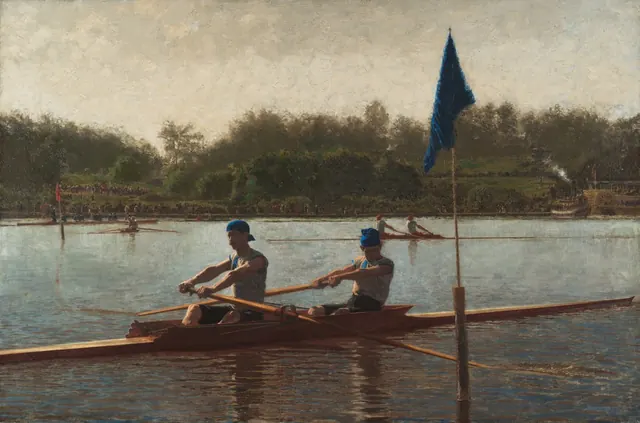
The painting’s story and details
In May 1872, thousands watched a five-mile race on Philadelphia’s Schuylkill River. The New York oarsmen John and Barney Biglin defeated their Pittsburgh rivals. Thomas Eakins made several paintings of the contest. For this Cleveland version, painted in 1873, he chose the turn around the marker at the halfway point. The brothers are already ahead, but still have to round the stake and return along the river. Their advantage depends on a precise manoeuvre.
The rower on the left extends his arms. Light picks out the muscles, and his white shirt makes the angle of his torso clear. Eakins was an enthusiastic rower himself, familiar with the action of an oar and hull. His compositions rested on carefully prepared figure studies and perspective drawings. This pose matters because of the task it performs: a person applying force to a particular tool. The hands meet on the oar handle, and the torso’s angle relates to the rower drawing it towards him.
The second brother lowers his head, extending his arms almost at chest level. Similar blue caps and shirts unite the athletes, while the positions of their hands and oars differ. Each holds one oar. Together they must propel the boat and change its direction beside the turning marker. Intersecting lines make that dependence visible. From this close viewpoint, we can examine the mechanics of movement that would be difficult to see from the bank.
The blue flag rises high above the boat. Its pole is almost vertical, while the oars spread diagonally and the long hull crosses the foreground. The fixed marker makes the turning distance clear. It stands directly in front of the gunwale, separating the athletes from us. The river is broad, yet this is where the long boat and its projecting oars have to negotiate the confined space around the stake.
Small eddies appear behind the oar on the right. Light and dark bands around the hull show the surface disturbed by the boat. Eakins does not cover the river with uniform ripples: near moving objects, his strokes change direction. This is part of his realism. The image convinces through coordinated details, with body position, oar angle and marks on the water belonging to the same action. An attractive river view also explains how the race takes place.
The rivals in red caps are farther away on the right. Spectators line the bank, with other boats and a steamboat beside the water. After the Civil War, rowing was among America’s most popular spectator sports, and the Biglins were celebrated professionals. Eakins presents their public success through physical work. The crowd establishes the scale of the event but occupies less of the painting than the two people on whom its outcome depends.
An ordinary spectator on the bank could not have this view. We are beside the champions at the difficult point of their manoeuvre, making the sports scene something like a portrait of professional skill. Eakins chooses what deserves close representation in modern America. Here it is the concentrated work of two oarsmen. Even knowing that they won, we can examine the scene piece by piece and see the particular efforts behind a celebrated result.
Featured in tours
American landscape. Land and its inhabitants
Nature, territorial expansion, the Civil War and urban life in American painting.
More paintings to compare

Period, style and subject
- Movement
- Realism
- Genre
- Everyday life
- Medium
- oil on canvas
- Collection
- Cleveland Museum of Art
- Dimensions
- Unframed, 101.3 × 151.4 cm
- Accession number
- 1927.1984
Sources
Image provided under CC0. Image licence